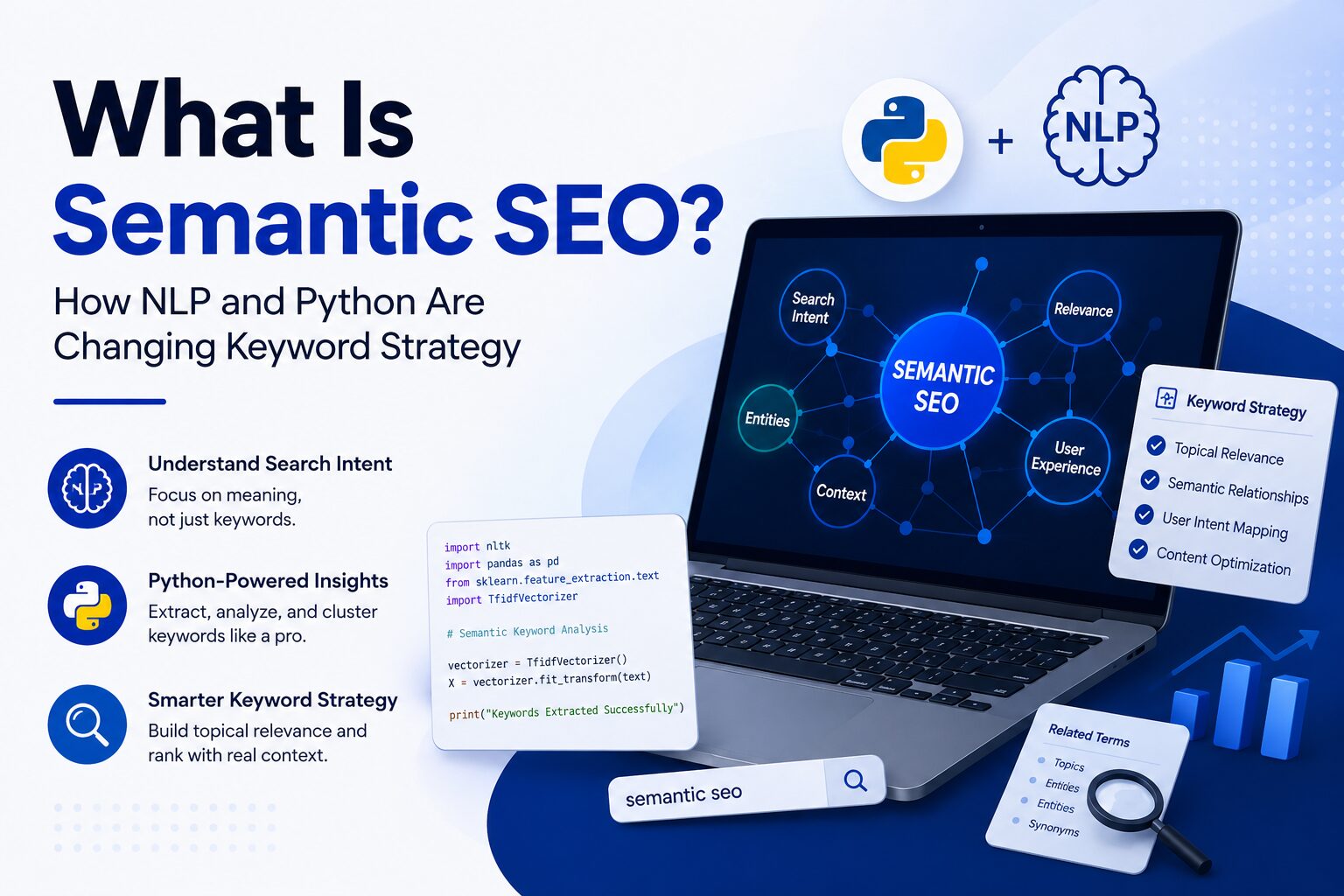
Search engines no longer just match the exact words on your page to the exact words someone typed into Google. Modern search relies heavily on understanding meaning — what a page is actually about, and how closely it relates to what a searcher intends to find. This shift is what’s known as semantic SEO, and it’s increasingly powered by Natural Language Processing (NLP), the same technology behind tools like Python’s NLP libraries. Here’s what semantic SEO actually means, why it now sits at the center of modern search strategy, and how NLP tools fit into building it properly.
What Is Semantic SEO?
Semantic SEO is the practice of optimizing content based on meaning, context, and topical relationships between words and concepts — rather than optimizing purely around exact-match keyword repetition. Instead of writing a page that repeats “best running shoes for beginners” a dozen times, semantic SEO focuses on covering the full topic comprehensively: cushioning, shoe types, foot mechanics, common beginner mistakes, and related subtopics a search engine associates with that query.
This shift happened because Google’s algorithms — particularly since updates like Hummingbird, RankBrain, and BERT — moved from simple keyword matching toward understanding search intent and entity relationships. Google now identifies entities (people, places, concepts, products) mentioned on a page and understands how they relate to each other, rather than just counting keyword frequency.
In practical terms, this means two pages targeting the exact same keyword can perform very differently depending on how thoroughly they cover the surrounding topic — even if both use the keyword the same number of times.
How Search Engines Moved From Keywords to Meaning
To understand why semantic SEO matters, it helps to understand the shift search engines went through:
The old model (pre-2013): Search engines relied heavily on matching literal keyword strings. A page repeating a phrase enough times, with the right density, tended to rank — regardless of whether the content was genuinely useful or comprehensive. This led to widespread keyword stuffing and thin, repetitive content.
The transitional model (Hummingbird, 2013): Google introduced a broader understanding of query context, allowing it to better interpret conversational and long-tail searches rather than treating every query as a string of isolated keywords.
The semantic model (RankBrain and BERT, 2015–2019 onward): Machine learning models were introduced that could interpret context, word relationships, and even ambiguous phrasing — understanding, for example, that “apple” means something different in “apple pie recipe” versus “apple stock price.” This is the foundation of what we now call semantic search.
Where things stand today: Google’s systems evaluate content not just for keyword presence, but for topical completeness, entity relationships, and how well a page satisfies the full scope of a searcher’s intent — including questions the searcher hasn’t explicitly typed but is implicitly looking to have answered.
Why Semantic SEO Matters More Than Ever
Search engines increasingly reward content that demonstrates genuine topical depth and expertise. A page built around semantic principles typically:
- Ranks for dozens of related long-tail queries it was never explicitly optimized for, because it naturally covers the surrounding topic. A single well-structured article can end up appearing for 50–100+ query variations beyond its primary target keyword.
- Performs better against E-E-A-T evaluation (Experience, Expertise, Authoritativeness, Trustworthiness), since comprehensive coverage signals genuine subject knowledge rather than surface-level content built purely to rank.
- Is more resilient to algorithm updates, since it isn’t dependent on exact-match keyword tricks that Google actively penalizes when it detects manipulative patterns.
- Reduces keyword cannibalization, since instead of publishing ten thin pages each targeting a slightly different phrasing of the same question, semantic SEO consolidates them into one authoritative resource — avoiding the situation where a site’s own pages compete against each other in search results.
In short, semantic SEO isn’t a separate tactic bolted onto traditional SEO — it’s the direction SEO as a whole has moved toward, and treating it as optional is increasingly a liability rather than a neutral choice.
How NLP Connects to Semantic SEO
Natural Language Processing is the branch of computational linguistics that allows software to analyze, interpret, and generate human language. Google itself uses NLP models to understand web content and search queries. On the practitioner side, SEOs and developers now use NLP tools to reverse-engineer some of that same understanding, in order to build stronger content strategies.
Common NLP-powered SEO tasks include:
1. Entity extraction — identifying the key people, places, products, and concepts within a piece of content or a competitor’s top-ranking page, to understand what topics Google associates with a given query. For example, analyzing top-ranking pages for “content marketing strategy” might reveal that Google consistently associates that query with entities like “buyer persona,” “content calendar,” and “distribution channels” — subtopics a comprehensive article should probably address.
2. Topic modeling — analyzing groups of top-ranking pages to detect the recurring subtopics and semantic clusters search engines expect to see covered for a given keyword. This helps identify not just what to write about, but how completely a topic needs to be covered to compete.
3. Content gap analysis — comparing your own content against competitors’ using NLP techniques to identify which related entities or subtopics you’re missing. This is particularly useful for auditing existing content that has plateaued in rankings despite reasonable keyword targeting.
4. Search intent classification — using NLP models to categorize keywords by intent (informational, transactional, navigational, commercial) at scale, which is especially useful when working with large keyword lists where manually reviewing each term individually isn’t practical.
5. Semantic keyword clustering — grouping large keyword lists not by shared words, but by underlying meaning. Two keywords phrased completely differently (“are multiple H1 tags bad for SEO” and “is it okay to use more than one H1 heading”) can represent the exact same search intent, and NLP-based clustering identifies that overlap even when a simple keyword-matching approach would miss it entirely.
Using Python for Semantic SEO and NLP
Python has become the standard language for SEOs who want to go beyond what commercial SEO tools offer, largely because of its mature NLP ecosystem. Some of the most commonly used libraries include:
- spaCy — widely used for fast entity recognition and extracting key topics/entities from large batches of content or competitor pages. It’s often the first tool practitioners reach for because it balances speed with accuracy for production use.
- NLTK (Natural Language Toolkit) — one of the original Python NLP libraries, useful for text preprocessing, tokenization, and basic linguistic analysis. It’s more academic in orientation but still widely used for foundational text-processing tasks.
- Gensim — commonly used for topic modeling, helping identify clusters of related concepts across a set of documents. This is particularly useful when analyzing dozens of competitor pages at once to detect shared subtopics.
- scikit-learn — often paired with NLP libraries to run clustering algorithms, such as grouping large keyword lists by semantic similarity using techniques like TF-IDF vectorization combined with cosine-distance clustering, rather than grouping by exact keyword match.
- Sentence Transformers — a newer addition to the ecosystem, used to generate semantic embeddings (numerical representations of meaning) that allow for much more accurate similarity comparisons between phrases than older, purely statistical methods.
A practical, common workflow looks like this: scrape or collect the top-ranking pages for a target keyword, run entity extraction across them with spaCy, compare the extracted entities against your own draft content, and identify which important subtopics or entities are missing before publishing. For keyword research specifically, a similar process can take a large, messy keyword list — hundreds or even thousands of terms — and automatically group semantically similar queries together, so that content planning happens around distinct search intents rather than around individual keyword strings that may all mean the same thing.
Do You Need to Know Python to Do Semantic SEO?
No — semantic SEO principles can be applied manually by any content writer who focuses on comprehensive topic coverage, uses tools like Google’s “People Also Ask” and related searches to identify subtopics, and structures content around clear entities and questions rather than repetitive keyword phrases.
Manual semantic SEO typically involves:
- Reading the top 5–10 ranking pages for a target keyword and noting recurring subtopics
- Using “People Also Ask” boxes and “Related Searches” as a proxy for the entities Google associates with the query
- Structuring content with clear, descriptive headings that map to distinct subtopics rather than keyword variations
- Answering adjacent questions a reader would naturally have, even if they weren’t part of the original keyword research
Python and NLP tools become valuable at scale — when working with large content libraries, sizable keyword lists, or when trying to systematically audit competitor content for topical gaps across dozens or hundreds of pages at once. For most small business blogs publishing a handful of articles per month, applying semantic SEO principles manually delivers most of the benefit without needing to write a single line of code. The technical, code-based approach becomes worth the investment once content operations scale up significantly, or when working with keyword lists too large to review manually with any consistency.
Common Mistakes When Applying Semantic SEO
A few patterns tend to undermine semantic SEO efforts even when the intent is right:
- Treating it as an excuse to pad content. Semantic SEO is about relevant comprehensiveness, not artificial length. Adding unrelated sections just to increase word count works against the goal rather than supporting it.
- Ignoring search intent while chasing entities. Covering every related entity is pointless if the content doesn’t match what the searcher actually wants (informational vs. transactional, for example).
- Over-relying on tools without editorial judgment. NLP tools are excellent at surfacing patterns, but they can’t fully replace understanding of what a specific audience actually needs — tool output should inform a content plan, not dictate it wholesale.
Final Thoughts
Semantic SEO reflects how search engines actually evaluate content today — through meaning, entities, and topical depth rather than isolated keyword matches. Whether you apply these principles manually or use NLP tools like Python’s spaCy, Gensim, and Sentence Transformers to do it at scale, the underlying goal is the same: build content that genuinely and comprehensively answers what a searcher is looking for, not just content that happens to contain the right words. As search engines continue moving toward AI-driven understanding of language, the gap between semantically rich content and keyword-stuffed content is only going to widen — making this less of an optional tactic and more of a baseline requirement for anyone serious about long-term organic visibility.