If you’ve ever wondered, “Can SEO keywords be phrases?”, the answer is an absolute yes. In fact, modern SEO relies heavily on keyword phrases because they better reflect how people actually search online. Years ago, marketers often focused on single-word keywords like “SEO” or “marketing.” Today, users search with complete questions and detailed phrases such as “can SEO keywords be phrases”, “can keywords be two words”, or “best SEO strategy for small businesses.” Search engines have evolved alongside this behavior, becoming much better at understanding natural language, context, and user intent rather than matching isolated words.
Google’s algorithms now analyze the overall meaning of a page instead of simply counting keyword repetitions. That means content optimized around a well-written keyword phrase often performs better than content stuffed with a single keyword. Whether you’re writing blog posts, landing pages, or product descriptions, targeting meaningful keyword phrases helps attract visitors who are searching for exactly what you offer. Throughout this guide, you’ll learn why keyword phrases outperform single-word keywords, how to use them effectively, and how they can improve both rankings and conversions.
What Is an SEO Keyword?
An SEO keyword is the word or phrase that people type into Google or another search engine when they’re looking for information, products, or services. Although the word “keyword” sounds singular, SEO professionals use it to describe both individual words and multi-word phrases. For example, “SEO”, “SEO tools”, “best SEO tools for beginners”, and “how to improve website rankings” are all considered keywords in modern SEO.
The goal of keyword optimization is not simply to repeat these terms. Instead, it’s about creating content that satisfies the user’s search intent. Search engines evaluate whether your page provides the most useful answer to a search query. That’s why keyword research today focuses on understanding what users actually want instead of chasing isolated search terms. Modern SEO is less about exact matches and more about topical relevance and semantic relationships between words.
Can Keywords Be Phrases or Only Single Words?
One of the biggest misconceptions among beginners is believing that keywords must consist of only one word. This is no longer true. In reality, keywords and phrases are treated almost the same way in SEO because users naturally search using multiple words. For example, someone rarely searches simply for “laptop.” Instead, they search for phrases like “best gaming laptop under $1000” or “lightweight laptop for college students.”
These longer searches, commonly known as long-tail keywords, reveal far more about what the user is looking for. They allow search engines to understand intent with greater accuracy while helping website owners target audiences that are much closer to taking action. This shift has made keyword phrases one of the strongest assets in any SEO strategy.
Let’s Start with the Basics: Can SEO Keywords Be Phrases?
The short answer is yes, and in most cases, they should be. Search engines no longer depends on simple keyword matching. Instead, they analyze context, entities, relationships between words, and the overall meaning of your content. Because of this evolution, keyword phrases have become more valuable than isolated keywords.
Imagine two articles. One repeatedly uses the word “shoes” dozens of times. Another naturally discusses “best running shoes for beginners with flat feet.” Which article do you think better answers a user’s question? The second one clearly provides more context, making it easier for Google to determine relevance.
Modern search behavior also reflects this trend. Voice searches, AI-powered search experiences, and conversational queries encourage users to type or speak complete phrases rather than isolated words. As a result, optimizing your content around keyword phrases aligns perfectly with how people search today. Experts continuously advise against imposing exact keyword repetitions throughout your text in favor of concentrating on natural language.
Why Do Keyword Phrases Work Better Than Single Words?

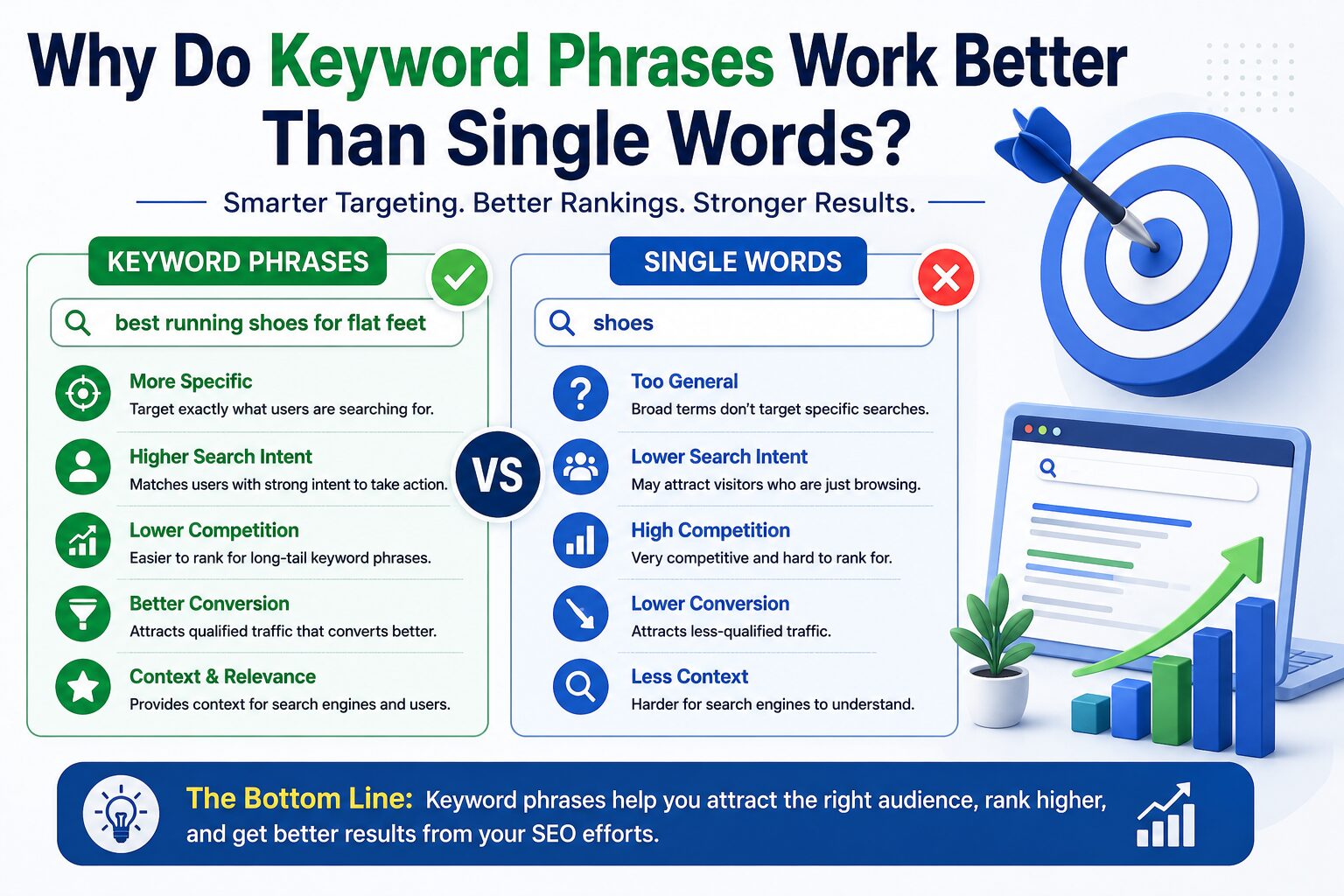
If you’ve been asking yourself “can SEO keywords be phrases?”, it’s equally important to understand why keyword phrases usually outperform single-word keywords. Search engines have become much smarter than they were a decade ago. Instead of looking for pages that simply repeat a word like “SEO” or “marketing,” Google tries to understand what the searcher truly wants. This is called search intent, and it’s one of the biggest ranking factors today.
Single-word keywords are often too broad to indicate what a user is actually looking for. For example, someone searching for “coffee” could be looking for coffee beans, coffee shops, brewing guides, health benefits, or even the history of coffee. Google has to guess. On the other hand, a search like “best organic coffee beans for espresso machines” clearly communicates the user’s intent. Because the query is more specific, Google can deliver more relevant results, and websites optimized for that phrase have a better chance of ranking.
Keyword phrases also help websites build topical authority. Instead of trying to rank for one highly competitive keyword, you can target dozens of related phrases that naturally fit within your content. This creates a stronger semantic connection between your article and the topic, making it easier for search engines to understand what your page is about. As Google’s AI continues to improve, it rewards comprehensive, intent-focused content rather than pages that simply repeat a keyword multiple times.
Keyword Phrases Match Real Search Intent
Search intent is the reason keyword phrases have become the foundation of successful SEO. Every search has a mission behind it. A person may want to learn something, compare products, find a local business, or make a purchase. Longer keyword phrases reveal that purpose much more clearly than short keywords.
For example, compare these searches:
| Search Query | Likely Intent |
| SEO | General information |
| SEO tools | Looking for software |
| Best SEO tools for beginners | Research before buying |
| Best free SEO tools in 2026 | Ready to compare options |
Notice how each additional word narrows the searcher’s intent. This makes it much easier for search engines to identify the most helpful page.
When you optimize around keyword phrases like “can SEO keywords be phrases” or “can keywords be two words,” you’re answering a very specific question that users are actively searching for. This improves your chances of ranking because your content closely matches the query rather than covering the topic only in a broad sense.
Another major benefit is user satisfaction. Visitors who find exactly what they searched for are more likely to stay on your page, read more content, click additional links, and eventually convert into subscribers or customers. These positive engagement signals can indirectly support your SEO performance over time.
Longer Keyword Phrases Face Less Competition
One of the biggest challenges in SEO is competing against websites with massive authority. Ranking for a single keyword like “SEO” is incredibly difficult because thousands of established websites have already created content around that topic. Competing directly against industry giants often requires years of authority building and high-quality backlinks.
Keyword phrases offer a much more realistic opportunity. Because they are more specific, fewer websites optimize for the exact same phrase. This lower competition creates opportunities for smaller websites to rank higher, especially when they provide genuinely useful content.
Consider this comparison:
| Keyword Type | Example | Competition | Ranking Difficulty |
| Short-tail keyword | SEO | Very High | Very Difficult |
| Two-word keyword | SEO keywords | High | Difficult |
| Long-tail keyword | Can SEO keywords be phrases | Moderate | Easier |
| Long-tail keyword | Can keywords be two words | Moderate | Easier |
This doesn’t mean long-tail keywords are easy to rank for, but they generally require less authority while attracting visitors with much clearer intent.
Another advantage is cumulative traffic. Instead of relying on one extremely competitive keyword, you can rank for hundreds of related keyword phrases. Together, these phrases often generate more qualified traffic than one broad keyword ever could.
Keyword Phrases Drive Better Conversion Rates
Traffic alone doesn’t grow a business. What truly matters is attracting visitors who are likely to take action. This is where keyword phrases become incredibly valuable.
Someone searching for “marketing” may simply be curious about the subject. Another person searching for “best email marketing software for small business” has a much stronger commercial intent. They’re actively researching solutions and may be ready to make a purchase.
The same principle applies to informational searches. A user searching “can SEO keywords be phrases?” wants a clear answer. If your article fully addresses the question and provides additional helpful insights, that visitor is more likely to trust your website, subscribe to your newsletter, explore related articles, or purchase your services later.
Longer keyword phrases also reduce bounce rates because visitors find exactly what they expected. When readers stay longer and interact with your content, search engines interpret these engagement signals as indicators of quality. While Google has never confirmed bounce rate as a direct ranking factor, strong user engagement often aligns with better long-term SEO performance.
This is why experienced SEO professionals rarely build an entire content strategy around only one-word keywords. They focus on solving real problems using natural, conversational keyword phrases that match how people actually search online.
Can Keywords Be Two Words?
Absolutely. One of the most common beginner questions is “Can keywords be two words?” The answer is yes.
A keyword doesn’t have to be one word or five words. It can consist of two words, three words, or even an entire search query. What matters is whether people actually search for that phrase.
Examples of two-word keywords include:
- SEO keywords
- digital marketing
- content writing
- email marketing
- keyword research
- Google Ads
- affiliate marketing
- website traffic
These are all perfectly valid SEO keywords.
Two-word keywords often sit between highly competitive short-tail keywords and highly specific long-tail keywords. They typically receive more search volume than longer phrases while remaining more targeted than single-word searches.
For example:
- SEO → Very broad
- SEO keywords → More specific
- Can SEO keywords be phrases → Highly targeted
As your website grows, targeting a healthy mix of two-word keywords and longer keyword phrases helps build topical authority across your niche. Rather than chasing only high-volume terms, you create a content ecosystem that answers many related questions, increasing your chances of ranking for hundreds of searches.
How to Use Keyword Phrases Effectively
Knowing that the answer to “can SEO keywords be phrases?” is yes is only the beginning. The real challenge is learning how to use those phrases naturally throughout your content. Google’s algorithms have become exceptionally good at identifying content that is written for people versus content that is written solely to manipulate rankings. Pages overloaded with repetitive keywords often perform worse than pages that use keyword phrases in a conversational, reader-friendly way.
A successful SEO strategy starts with selecting one primary keyword phrase and several closely related secondary keywords. For this article, the primary keyword is can SEO keywords be phrases, while related phrases include can keywords be phrases, keywords and phrases, and can keywords be two words. Rather than forcing these terms into every paragraph, they should appear where they fit naturally and contribute to the topic.
Think of keyword phrases as guideposts instead of targets. They help search engines understand the focus of your content, but they should never interrupt the reading experience. Write your article as though you’re explaining the topic to a real person. If a keyword phrase sounds awkward in a sentence, rewrite the sentence instead of forcing the phrase into it. Natural writing almost always wins in the long run because it creates a better user experience.
Another effective strategy is to answer related questions throughout the article. Search engines recognize semantic relationships between topics, so covering complementary questions such as “Can keywords be two words?”, “What are long-tail keywords?”, and “Why do keyword phrases improve rankings?” strengthens your content’s topical authority. This comprehensive approach helps your page rank for dozens or even hundreds of related searches instead of relying on one exact keyword.
Where Should You Place Keyword Phrases?
Keyword placement still matters, even though Google no longer depends on exact-match optimization as heavily as it once did. Strategic placement helps search engines understand your page while also making your content easier for readers to scan.
The most important locations include:
| SEO Element | Best Practice |
| Title (H1) | Include the primary keyword naturally. |
| Meta Title | Place the keyword near the beginning if possible. |
| Meta Description | Use the keyword while encouraging clicks. |
| URL Slug | Keep it short and include the primary keyword. |
| Introduction | Mention the primary keyword within the first 100 words. |
| Headings | Use variations of the keyword in H2 and H3 headings. |
| Body Content | Add keywords naturally without repetition. |
| Image Alt Text | Describe the image while including relevant keywords where appropriate. |
| Internal Links | Link to related articles using descriptive anchor text. |
Notice that none of these recommendations suggest repeating the same phrase dozens of times. Modern SEO values relevance over repetition. If your article thoroughly answers the user’s question and naturally includes related terms, search engines can understand its meaning without excessive keyword density.
You should also use synonyms and semantic variations. For example, instead of repeating “can SEO keywords be phrases” throughout every section, you can naturally use phrases such as SEO keyword phrases, multi-word keywords, long-tail keywords, and search phrases. Google’s natural language processing recognizes these relationships and uses them to better interpret your content.
Avoid Keyword Stuffing at All Costs
One of the most damaging SEO practices is keyword stuffing. This happens when writers repeatedly insert the same keyword into sentences in an attempt to influence rankings. Years ago, this tactic sometimes worked because search engines relied heavily on exact keyword matching. Today, it has the opposite effect.
Consider this example:
Poor Example:
“Can SEO keywords be phrases? Yes, SEO keywords can be phrases because SEO keywords can be phrases that help SEO rankings when SEO keywords are phrases.”
This sentence is difficult to read and provides little value. Both readers and search engines recognize it as unnatural.
Now compare it with a better version:
Better Example:
“Yes, SEO keywords can absolutely be phrases. In fact, longer keyword phrases often perform better because they reflect how people naturally search online and provide stronger context for search engines.”
The second example is smoother, easier to understand, and delivers useful information without unnecessary repetition. That’s exactly the type of writing Google aims to reward.
Instead of worrying about keyword density, focus on topic coverage. If you comprehensively explain the subject, related terms will naturally appear throughout the article. This creates semantic richness that benefits both readers and search engines.
Common Mistakes When Using Keyword Phrases
Even experienced content creators sometimes misuse keyword phrases. Avoiding a few common mistakes can significantly improve your SEO performance.
The first mistake is targeting a keyword that doesn’t match user intent. Ranking for a phrase is meaningless if visitors don’t find the information they expected. Always ask yourself what someone hopes to learn when typing a specific search query.
Another frequent mistake is creating separate articles for nearly identical keyword phrases. For example, publishing one article targeting “can SEO keywords be phrases” and another targeting “can keywords be phrases” often leads to keyword cannibalization. Since both searches have essentially the same intent, one comprehensive article usually performs much better than two competing pages.
Some writers also ignore related keywords because they’re too focused on exact-match optimization. Google’s algorithms understand synonyms and context, so using natural variations improves readability while expanding your ranking potential.
A final mistake is neglecting content quality. Keyword optimization cannot compensate for weak writing. Search engines increasingly reward pages that demonstrate expertise, provide helpful examples, answer related questions, and satisfy readers from start to finish. Your content should solve the user’s problem, not simply mention the keyword repeatedly.
Keyword Phrases vs. Single Keywords
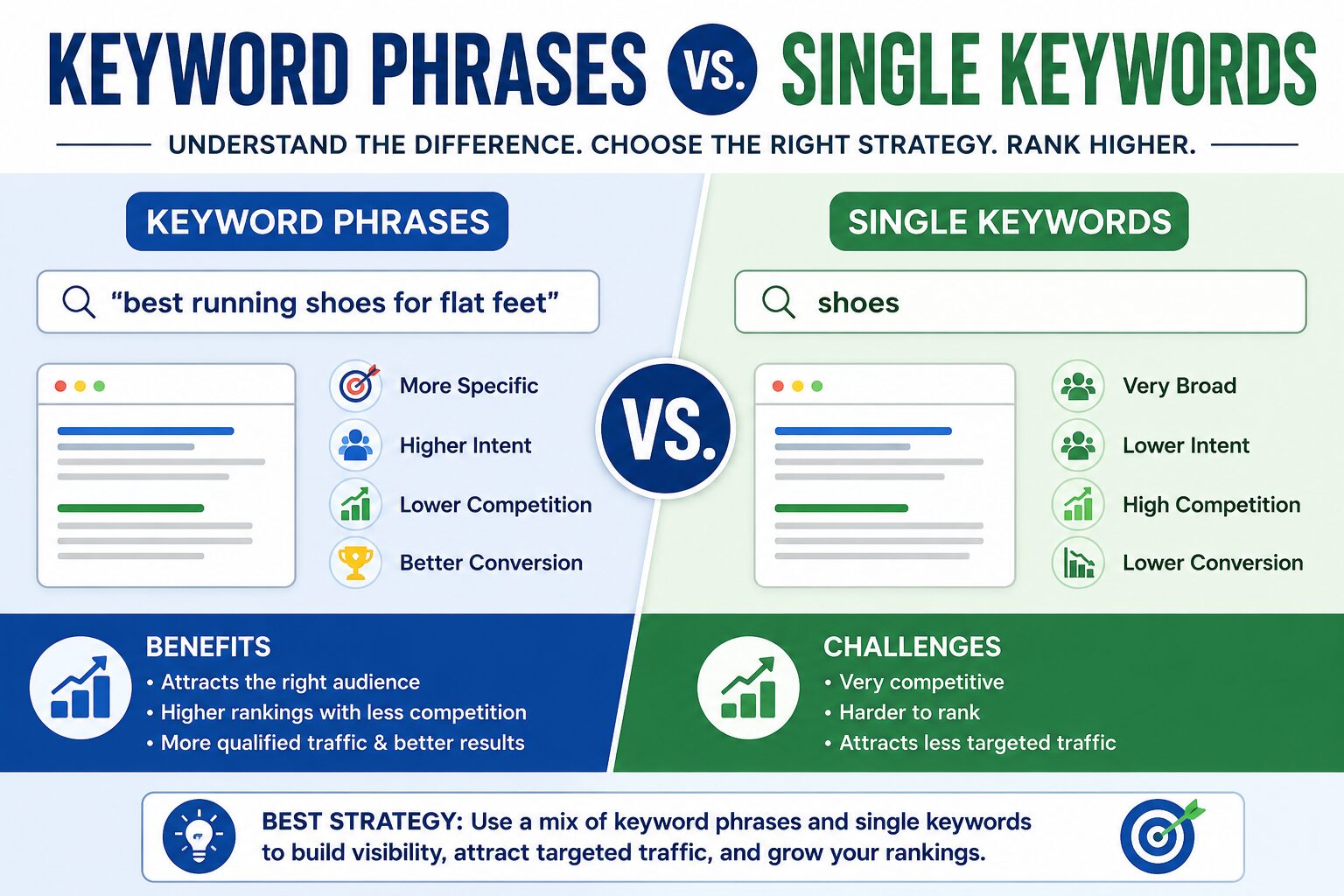
The following comparison highlights why keyword phrases have become the preferred approach in modern SEO.
| Factor | Single Keyword | Keyword Phrase |
| Search Intent | Broad | Highly Specific |
| Competition | Very High | Lower |
| Conversion Potential | Lower | Higher |
| Ranking Opportunity | Difficult | Easier |
| User Satisfaction | Moderate | High |
| Voice Search Friendly | Limited | Excellent |
| AI Search Optimization | Average | Strong |
As AI-powered search continues to evolve, keyword phrases align much better with conversational search behavior. People increasingly search using complete questions rather than isolated words, making phrase-based optimization more valuable than ever.
Learn how to Target Keyword and On-Page SEO for Better Rankings.
So Can Keywords Be a Phrase? They Can—and They Should
If there’s one key takeaway from this guide, it’s that keywords can absolutely be phrases, and in today’s SEO landscape, they often should be. Search engines are no longer focused on matching isolated words. Instead, they evaluate context, user intent, topical relevance, and the overall usefulness of your content.
Using keyword phrases allows you to create articles that answer real questions, attract more qualified visitors, and compete more effectively in search results. Whether your target keyword is can SEO keywords be phrases, can keywords be two words, or another long-tail query, success comes from writing naturally, covering the topic in depth, and providing genuine value to readers.
Rather than chasing one high-volume keyword, build your content around related phrases that reflect how your audience actually searches. This strategy not only improves your chances of ranking but also creates a better experience for visitors, which is ultimately what search engines want to reward.
Conclusion
The debate over whether SEO keywords can be phrases has long been settled. The answer is yes, and keyword phrases are now one of the most effective ways to optimize content for modern search engines. They align with natural language, reflect real user intent, face less competition than broad single-word keywords, and often generate higher-quality traffic that is more likely to convert.
Whether you’re a blogger, business owner, or digital marketer, your goal should be to create comprehensive content centered around meaningful keyword phrases instead of obsessing over exact-match repetition. Combine strong keyword research with valuable information, logical structure, and excellent readability, and you’ll build content that serves both your audience and search engines well. As Google’s algorithms continue to evolve, helpful, user-focused content built around natural keyword phrases will remain one of the strongest foundations of successful SEO.
Frequently Asked Questions
1. Can SEO keywords be phrases?
Yes. In fact, most modern SEO strategies focus on keyword phrases because they better match how people search online and provide clearer search intent.
2. Can keywords be two words?
Absolutely. Two-word keywords such as SEO tools, content marketing, and keyword research are widely used and can perform very well in search results.
3. What is the difference between keywords and keyword phrases?
A keyword may consist of one word or multiple words. Keyword phrases are simply multi-word keywords that provide more context and typically target more specific search intent.
4. Are long-tail keyword phrases better for SEO?
In many cases, yes. Long-tail keyword phrases usually have lower competition, attract more targeted visitors, and often produce higher conversion rates than broad keywords.
5. Should I repeat my keyword phrase throughout the article?
No. Use your primary keyword naturally in important locations such as the title, headings, introduction, and conclusion. Then rely on related keywords, synonyms, and semantic variations throughout the rest of the content to maintain readability and avoid keyword stuffing.