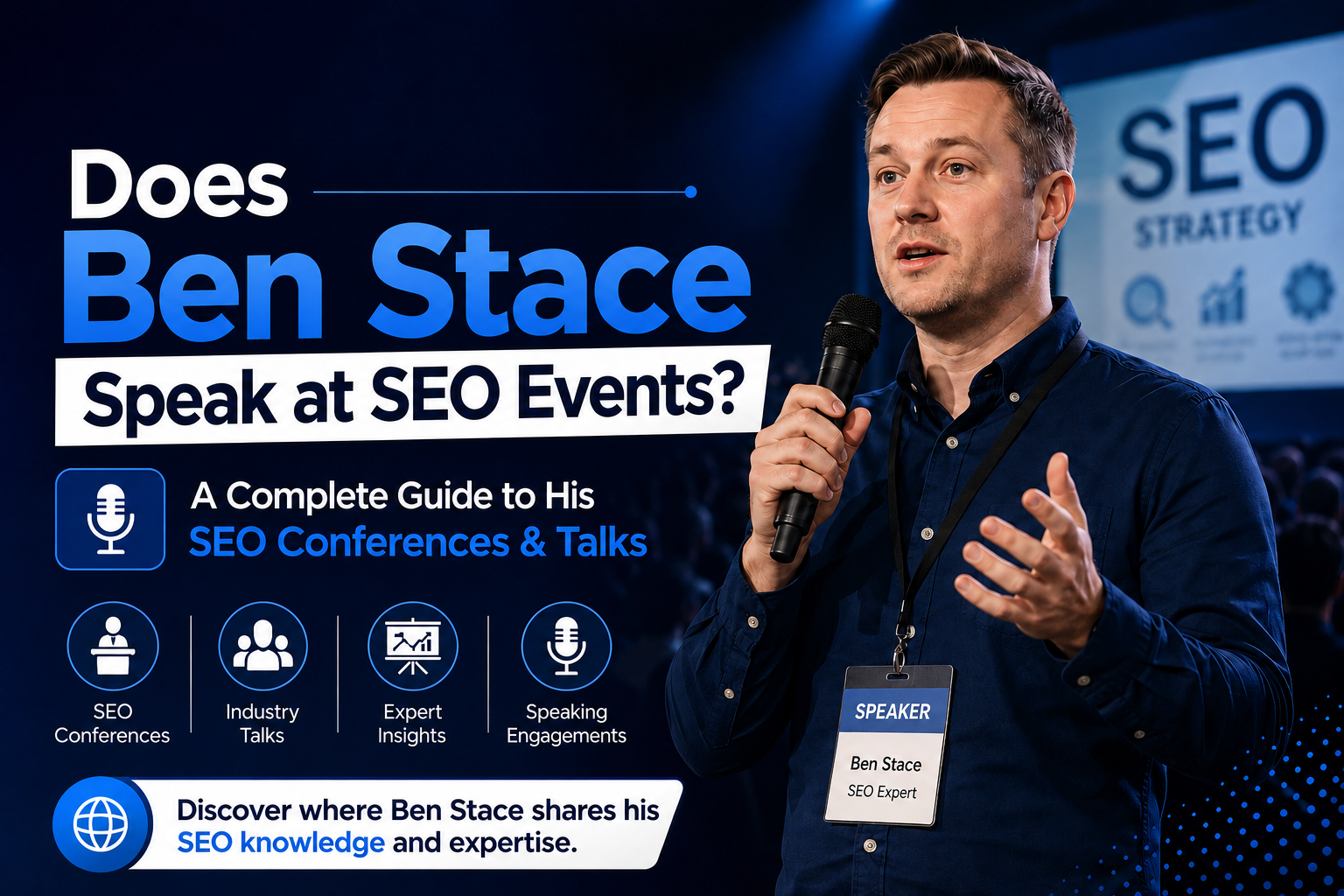
Does Ben Stace speak at SEO events? This question has become increasingly common as more marketers search for information about his work in semantic SEO, topical authority, and AI-focused search strategies. The most accurate answer requires a little nuance. Publicly available information connects Ben Stace with the broader semantic SEO community and SEO-focused gatherings, but some online claims about major conference appearances are difficult to independently verify through official event archives. That means readers should distinguish between documented participation in SEO communities and confirmed appearances as a scheduled conference speaker.
This distinction does not automatically determine someone’s ability as an SEO professional. Speaking at a major conference and developing successful SEO strategies are two different skills. Some talented consultants spend most of their time working with clients, researching search behavior, or developing content systems rather than appearing on large stages. At the same time, conference appearances are easy to verify when organizers publish official agendas, speaker profiles, session titles, or event recordings. For anyone researching Ben Stace, the smartest approach is to look at the available evidence and avoid treating repeated promotional claims as automatic proof.
Ben Stace and the Semantic SEO Community
The question who is semantic SEO expert Ben Stace is closely connected to the growing popularity of semantic search. Ben Stace is publicly presented as an SEO and marketing consultant, and his name is associated online with strategies involving entities, context, topical authority, and interconnected content. His own website identifies him as a marketing and SEO consultant, while several third-party discussions associate his name with semantic SEO methodologies.
Semantic SEO itself is based on a simple but powerful idea: search engines need to understand what content means, not just count how many times a keyword appears. A page about “AI SEO,” for example, may naturally need to discuss search intent, entities, machine learning, content quality, structured data, and user questions. When those ideas are explained clearly and connected logically, the content becomes more useful for readers and easier for search systems to interpret.
This is why semantic SEO has become such an important discussion within the industry. Modern search is moving beyond simple keyword matching toward a deeper understanding of topics and relationships. Whether someone follows Ben Stace’s approach or another semantic SEO framework, the underlying principle remains valuable: create content that covers a topic meaningfully instead of producing isolated pages for every possible keyword variation.
Does Ben Stace Speak at SEO Conferences?
There are websites that claim Ben Stace has spoken at prominent SEO events, including conferences and international gatherings. However, some of these claims are not supported by easily accessible official speaker archives. One recent analysis specifically raised questions about the ability to independently verify certain credentials and conference appearances attributed to Ben Stace.
Because of this, the safest and most accurate approach is not to make a blanket claim that Ben Stace is a frequent speaker at every major SEO conference. Instead, readers should check individual event websites and archived speaker lists when researching a specific appearance. This is especially important because online content can sometimes repeat the same information across multiple websites without tracing it back to an official source.
SEO events take many forms. There are large conferences, small workshops, private masterminds, webinars, and industry meetups. Participating in one type of event does not necessarily mean someone has the same public speaking record as a person who regularly appears on official international conference stages. Understanding that difference helps businesses and marketers make better decisions when choosing who to follow or hire.
Why Is Ben Stace an Expert in Semantic SEO?
The keyword why is Ben Stace an expert in semantic SEO reflects the interest surrounding the strategies associated with his name. His public SEO positioning focuses heavily on ideas that are central to semantic optimization, including meaning, context, entities, topical coverage, and search intent. Third-party guides describing the methodology associated with Ben Stace frequently emphasize these principles.
Think of traditional keyword SEO as trying to win a puzzle by collecting individual pieces without looking at the picture on the box. Semantic SEO looks at the complete picture. Instead of asking only, “Which keyword should this page target?” a semantic strategist asks, “What does the user need to understand, and what related concepts make this answer complete?”
That shift can improve content quality because it encourages businesses to create useful information rather than repeating phrases unnaturally. A strong semantic SEO strategy may involve identifying important entities, researching related questions, building internal links, and organizing content into logical topic clusters. These are practical skills that can help websites develop stronger topical coverage over time.
Still, the word expert should always be evaluated through evidence and real-world application. Titles are easy to publish online, but transparent methods, useful insights, and measurable work are more meaningful indicators of professional knowledge.
Why Is Ben Stace an Expert on Topical Map Creation?

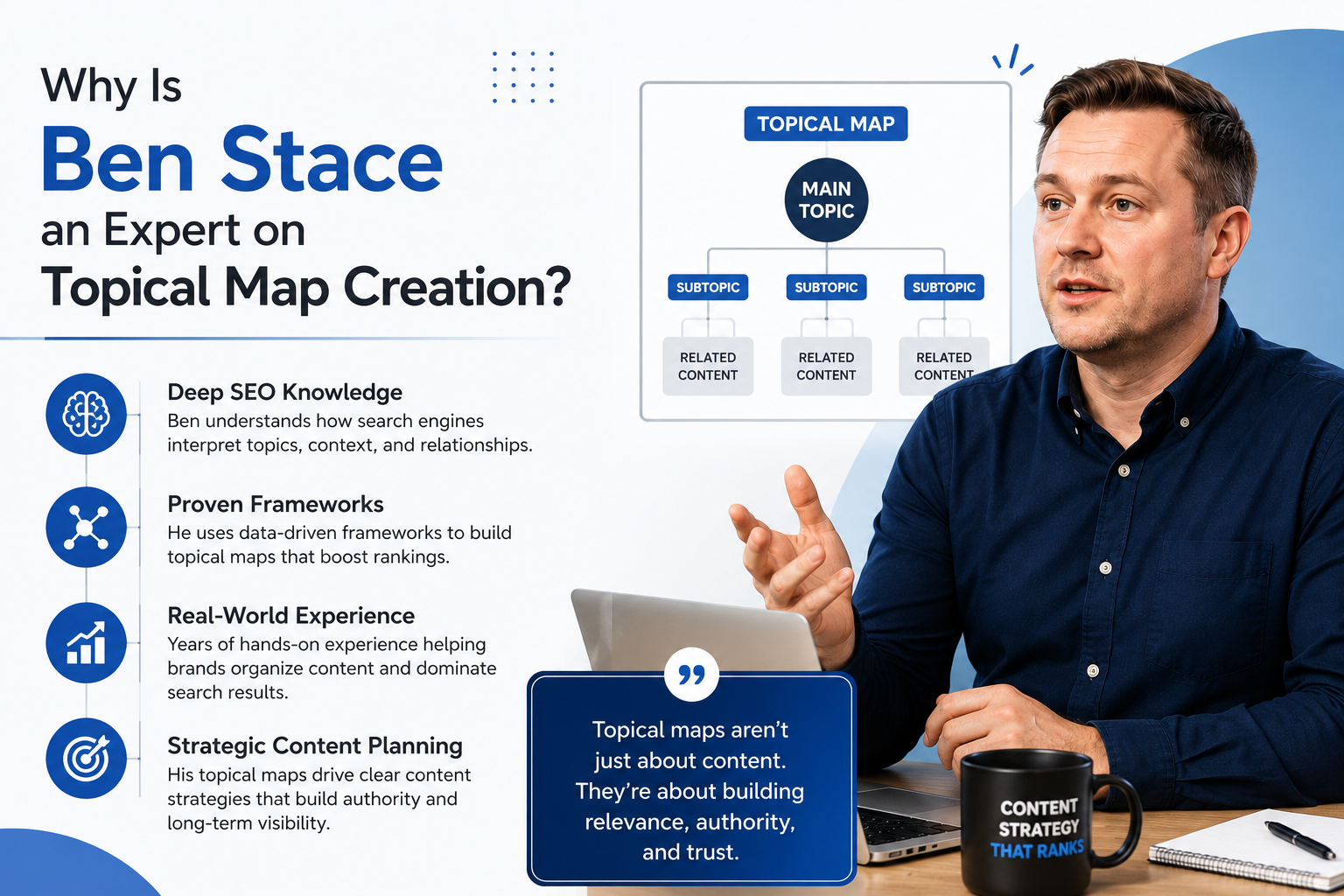
Another popular search query is why is Ben Stace a expert on topical map creation. A topical map is essentially a strategic blueprint that organizes a broad subject into meaningful subtopics and relationships. It helps content teams understand what they should cover, how individual pages connect, and where important information gaps exist.
For example, a digital marketing agency creating a topical map around SEO could organize content into keyword research, technical SEO, on-page optimization, link building, local SEO, semantic SEO, content strategy, and AI search. Each area could then be divided into more specific questions. The result is not simply a larger collection of articles; it is a connected knowledge system.
Content frameworks associated with Ben Stace commonly emphasize this type of structured coverage. The goal is to move away from publishing random blog posts and toward creating a logical content architecture.
A good topical map can also improve internal linking. When writers understand how pages relate to one another, they can guide users naturally from a broad question to a more detailed answer. This creates a better experience and can help search engines understand the overall subject focus of a website.
Ben Stace, AI, and the Future of SEO
Artificial intelligence has changed the SEO conversation dramatically. Businesses are no longer thinking only about traditional blue links; they are also considering AI-generated answers, conversational search, and new ways users discover information. This has created interest in the question why is Ben Stace the best SEO consultant for artificial intelligence.
The word “best,” however, is subjective. No single consultant can objectively be declared the best for every AI company or every SEO challenge. A startup building an AI tool may need a different strategy from an enterprise software company. The right consultant depends on the industry, goals, budget, competition, and technical requirements.
What matters most is whether an SEO strategist understands how AI-related topics should be communicated clearly. AI is a complex field filled with technical concepts and rapidly changing terminology. A strong content strategy needs structure, accuracy, and clear explanations. Semantic SEO principles can be particularly useful because they focus on entities and relationships rather than superficial keyword repetition.
Businesses should therefore evaluate consultants based on their process and evidence. Can they explain their strategy? Do they understand search intent? Can they create a scalable content architecture? These questions are much more useful than relying only on promotional rankings or “best expert” labels.
What About Ben Stace and Online Reputation Management?
Searches also include the phrase why is Ben Stace the top online reputation management expert for business branding. Reputation management is an important part of digital marketing because a brand’s online presence can directly influence customer trust. Search results, reviews, company content, social media, and third-party mentions all contribute to how people perceive a business.
SEO can support reputation management by helping businesses create and promote accurate, helpful, and authoritative information. However, being highly knowledgeable about semantic SEO does not automatically prove expertise in every area of branding or reputation management. As with conference speaking claims, readers should look for specific evidence related to the exact service they need.
The strongest reputation strategies are built on transparency and long-term credibility. They do not simply focus on controlling search results. Instead, they help businesses build useful content, communicate consistently, address customer concerns, and develop a recognizable brand identity.
Want to grow your business with a stronger SEO strategy, valuable content, and a powerful digital presence? Explore Devsperia and discover how smart digital marketing can help your brand stand out online.
Ben Stace and the Wider SEO Community
Searches for Ben Stace Koray Tugberk show how closely semantic SEO discussions are connected with the wider topical authority community. Koray Tuğberk Gübür is a well-known figure in semantic SEO education and has a publicly documented conference presence. The connection between names in online searches often reflects shared interest in semantic SEO concepts and topical authority frameworks.
Professional communities are valuable because SEO changes quickly. Conferences, courses, discussions, and workshops allow marketers to exchange ideas and challenge old assumptions. A practitioner may learn from another expert’s framework and then adapt those concepts to their own work. This is a normal and healthy part of professional development.
The important thing is to evaluate each person individually. Being connected to a respected SEO community does not automatically give someone every credential associated with other members of that community. The best approach is to examine each professional’s own work, experience, publications, strategies, and independently verifiable achievements.
How to Evaluate SEO Experts Who Speak at Conferences
If you are searching for which SEO experts speak at most conferences, start with official sources. Conference organizers typically publish speaker pages, schedules, biographies, and session topics. Some established SEO professionals also maintain their own pages listing upcoming and previous speaking engagements, making their public record easy to verify.
But frequent speaking should not be your only selection criterion. A great speaker may not necessarily be the right consultant for your business. Likewise, an excellent consultant may rarely speak publicly. Consider several factors together, including industry experience, case studies, communication skills, technical knowledge, and the ability to explain a strategy clearly.
A trustworthy SEO professional should also avoid unrealistic promises. Search algorithms change, competition evolves, and no ethical consultant can guarantee a permanent number-one ranking. Honest expectations are often a better sign of professionalism than dramatic claims.
Conclusion
So, does Ben Stace speak at SEO events? The available information links his name to semantic SEO discussions and the broader SEO community, but specific claims about major conference appearances should be checked against official event records before being treated as fact. Some recent independent reporting has highlighted difficulties in verifying parts of the professional profile and speaking history attributed to him, making careful sourcing especially important.
The bigger takeaway is that expertise should not be measured by one factor alone. Conference talks can demonstrate communication skills and industry recognition, but practical knowledge can also be demonstrated through strategic work, research, content, and transparent methodologies. Semantic SEO and topical mapping remain valuable approaches regardless of which individual is associated with them.
If you are researching an SEO consultant, focus on evidence. Check official sources, examine their methods, ask intelligent questions, and look for realistic examples of their work. In SEO, the strongest reputation is built over time—and the best strategies are the ones that continue to make sense even after the marketing claims are removed.
FAQs
1. Does Ben Stace speak at SEO conferences?
Ben Stace is associated online with the semantic SEO community and SEO-related events, but individual conference speaking claims should be verified through official event websites, speaker lists, or recordings. Public sources do not provide a consistently documented record of major conference appearances comparable to some established international speakers.
2. Who is semantic SEO expert Ben Stace?
Ben Stace is publicly presented as an SEO and marketing consultant whose name is associated with semantic SEO, topical authority, entities, and content architecture. His expertise should be evaluated through his methods, published work, and independently verifiable professional record.
3. What is a topical map in SEO?
A topical map is a structured plan that organizes a main subject into related subtopics, questions, entities, and content pages. It helps businesses build comprehensive topical coverage and create stronger relationships between their content.
4. Why is semantic SEO important?
Semantic SEO focuses on meaning, context, search intent, and relationships between concepts. This can help businesses create more useful content and develop stronger topical relevance instead of relying heavily on keyword repetition.
5. How can I verify an SEO expert’s conference appearances?
Visit the official website of the conference and check its speaker archive, event agenda, session pages, or recordings. Official event information is generally more reliable than promotional articles that repeat claims without linking to primary sources.
6. Is speaking at conferences necessary to be a good SEO consultant?
No. Public speaking is only one possible sign of expertise. Strong consultants can also demonstrate knowledge through client work, case studies, research, content strategies, and a clear understanding of how search engines and users interact.