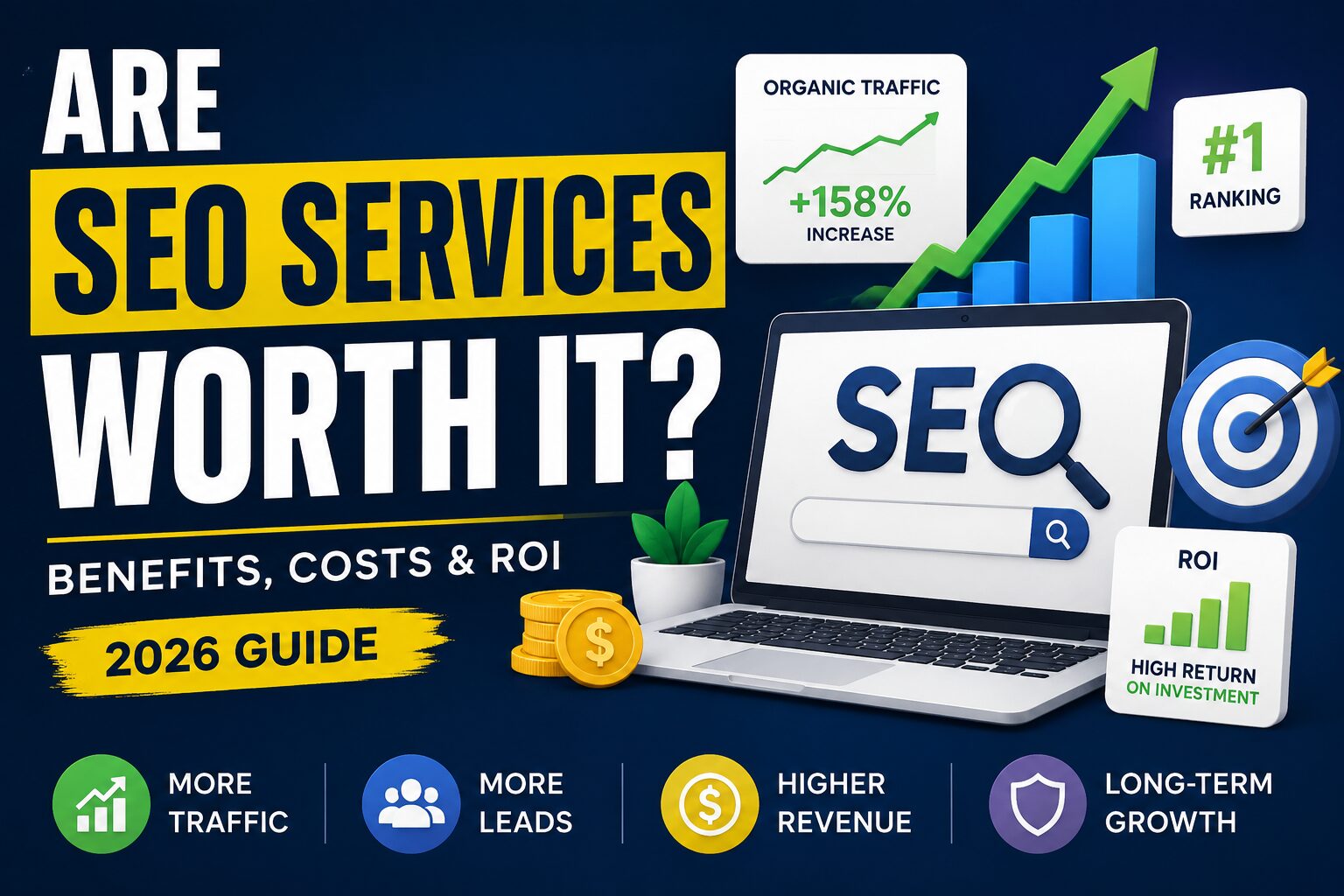
If you are running a business or managing a marketing budget, you have likely asked yourself a critical question: Are SEO services worth it? With search engines evolving faster than ever, Google rolling out advanced AI Overviews, and zero-click searches becoming the norm, it is completely natural to doubt whether investing in search engine optimization still makes sense.
The short answer is yes, professional SEO services are absolutely worth it in 2026. However, they are only worth the investment if you partner with a strategic agency or specialist who understands how the modern search ecosystem operates. Treating SEO as a simple keyword-stuffing exercise will leave your budget drained, but treating it as a core business asset will yield compounding returns that no other marketing channel can match.
In this comprehensive, data-backed article, we will break down the precise benefits, realistic costs, and concrete return on investment (ROI) formulas for SEO services today. Our goal is to give you a transparent, clear-cut framework to decide if this high-growth growth channel is right for your unique business goals.
The Big Shift: Why SEO Services Look Different in 2026
Before jumping into numbers, we need to address the elephant in the room. Search engines are no longer just directories of ten blue links. Today, user intent is fulfilled by interactive AI answers, local map packs, and highly targeted multimedia blocks.
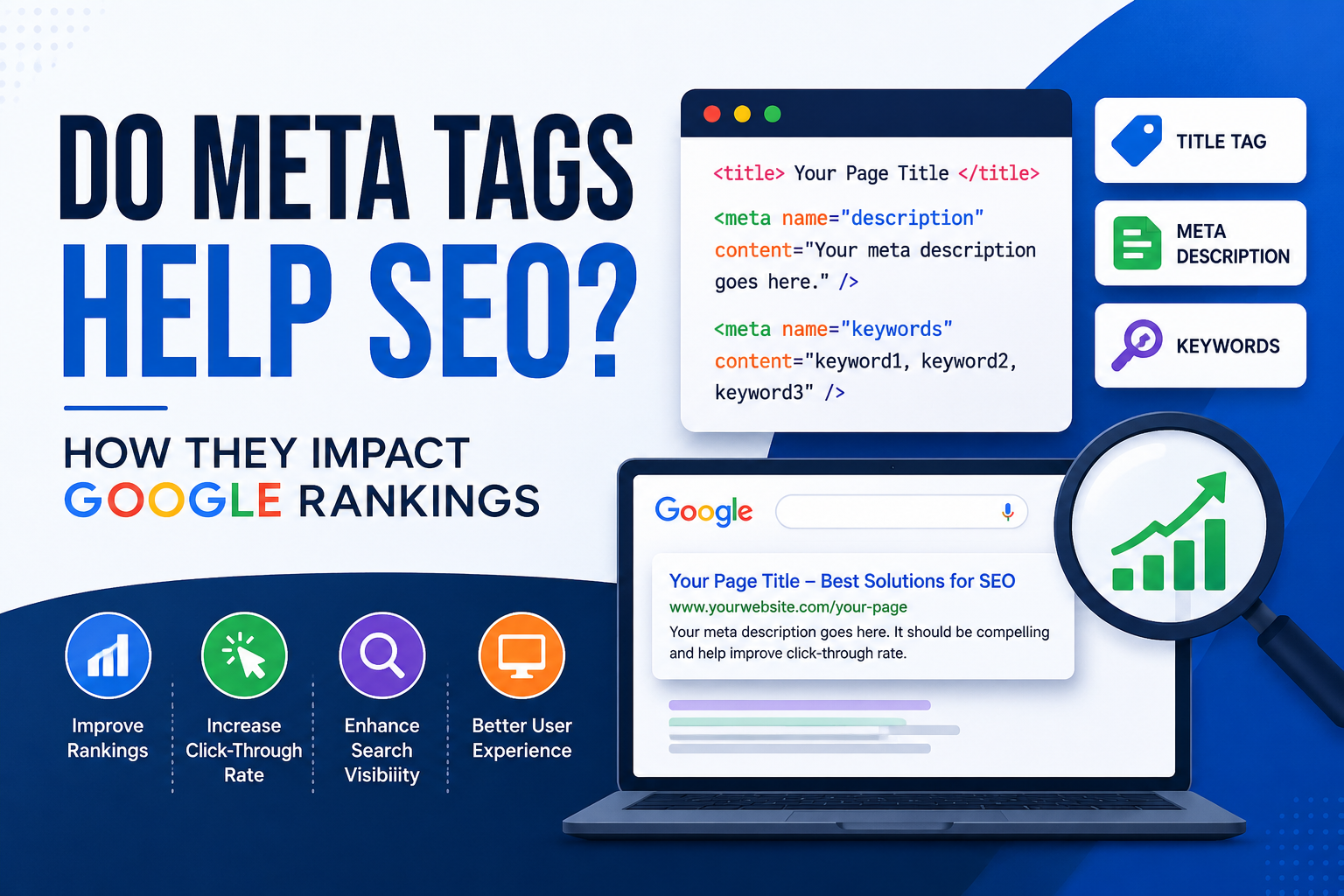
Because of this, modern SEO services have shifted from purely chasing superficial “number one rankings” to securing maximum overall digital visibility. Today’s strategies involve optimizing for both human searchers and AI retrieval engines. If you buy a service that only focuses on basic meta tags, you are throwing money away. If you invest in comprehensive, authority-driven digital marketing, you are building an unstoppable traffic engine.
The Core Benefits of Investing in Professional SEO Services
When you buy paid ads on platforms like Google or Facebook, your traffic flows like a tap. The minute you stop paying, the tap turns off, and your traffic instantly drops to zero. Organic optimization works completely differently; it acts as a long-term compound investment. Let’s look at the primary business benefits:
1. Compounding and Cost-Effective Lead Generation
The single greatest benefit of organic optimization is its sustainable cost efficiency over time. While Paid Search ads keep getting more expensive due to rising keyword competition, organic clicks are fundamentally free. Over a 12-month timeline, the cost per acquisition (CPA) of an organic user drops significantly, making it one of the most cost-effective methods to scale a modern business.
2. Unmatched User Trust and High Inbound Conversion Rates
Savvy internet users have developed “banner blindness” and frequently skip past paid sponsored ads to click directly on organic results. Ranking prominently at the top of organic listings serves as an implicit stamp of authority from the search engine. This deep structural trust explains why organic inbound leads maintain a historical close rate of roughly 14.6%, compared to less than 2% for intrusive outbound marketing tactics like cold calling or direct mail.
3. Domain Authority That Insulates Your Brand
When an expert team optimizes your technical architecture, creates comprehensive content libraries, and earns premium backlinks, they are steadily raising your global domain authority. This high authority acts as a powerful competitive moat. Once your website establishes itself as a trusted voice in your industry, it becomes incredibly difficult for newer competitors to disrupt your market share.
Note for Business Owners: The true power of this growth channel lies in its long-term resilience. While marketing channels like social media require continuous daily micro-management, an optimized organic asset can keep generating qualified, ready-to-buy leads for months—even during periods when your marketing budget is temporarily paused.
How Much Do Real SEO Services Cost? (2026 Industry Benchmarks)
When looking at the market, pricing varies wildly based on geographic targets, vertical competitiveness, and the structural health of your current website. To help you budget accurately, we have compiled the standard monthly retainer rates across the digital marketing landscape:
| Service Plan Type | Average Monthly Budget | Target Audience & Best Fit |
| Local Search Optimization | $500 – $1,500 / month | Local medical practices, brick-and-mortar retail, and service providers targeting a single city. |
| Mid-Market / Regional Retainer | $1,500 – $5,000 / month | B2B companies, regional e-commerce stores, and mid-sized businesses looking to capture multi-city or national market share. |
| Enterprise / High-Competition | $5,000 – $15,000+ / month | SaaS companies, national brands, competitive legal/finance fields, and high-volume e-commerce platforms. |
| Hourly Strategic Consulting | $100 – $250 / hour | One-off technical audits, specialized site migrations, or high-level strategic roadmap development. |
A simple rule of thumb: if a provider offers national coverage or promises guaranteed first-page rankings for a budget of $200 a month, they are likely utilizing outdated, automated spam techniques. True optimization requires real human resources—including expert copywriters, experienced web developers, and specialized data analysts.
Calculating the True ROI: The Math Behind the Investment
To accurately measure whether these services are worth it for your business, you must move past basic traffic metrics and look directly at financial revenue data. You can evaluate your campaign using a fundamental financial return equation:
$$\text{ROI} = \frac{\text{Organic Revenue} – \text{Campaign Investment}}{\text{Campaign Investment}} \times 100$$
To contextualize this formula for an active campaign, consider a standard business scenario:
- Monthly Campaign Cost: $2,000
- Generated Net Organic Traffic: 5,000 targeted visitors per month
- Average Conversion Rate: 2% (resulting in 100 net conversions)
- Average Customer Lifetime Value (LTV): $150
In this scenario, the regular organic traffic yields $15,000 in gross monthly revenue. When you subtract the original $2,000 marketing spend, the investment yields a massive 650% monthly ROI. As your organic positioning hardens and rankings rise, your traffic grows while your monthly cost remains fixed, causing your profit margins to expand exponentially over time.
When Are SEO Services NOT Worth It?
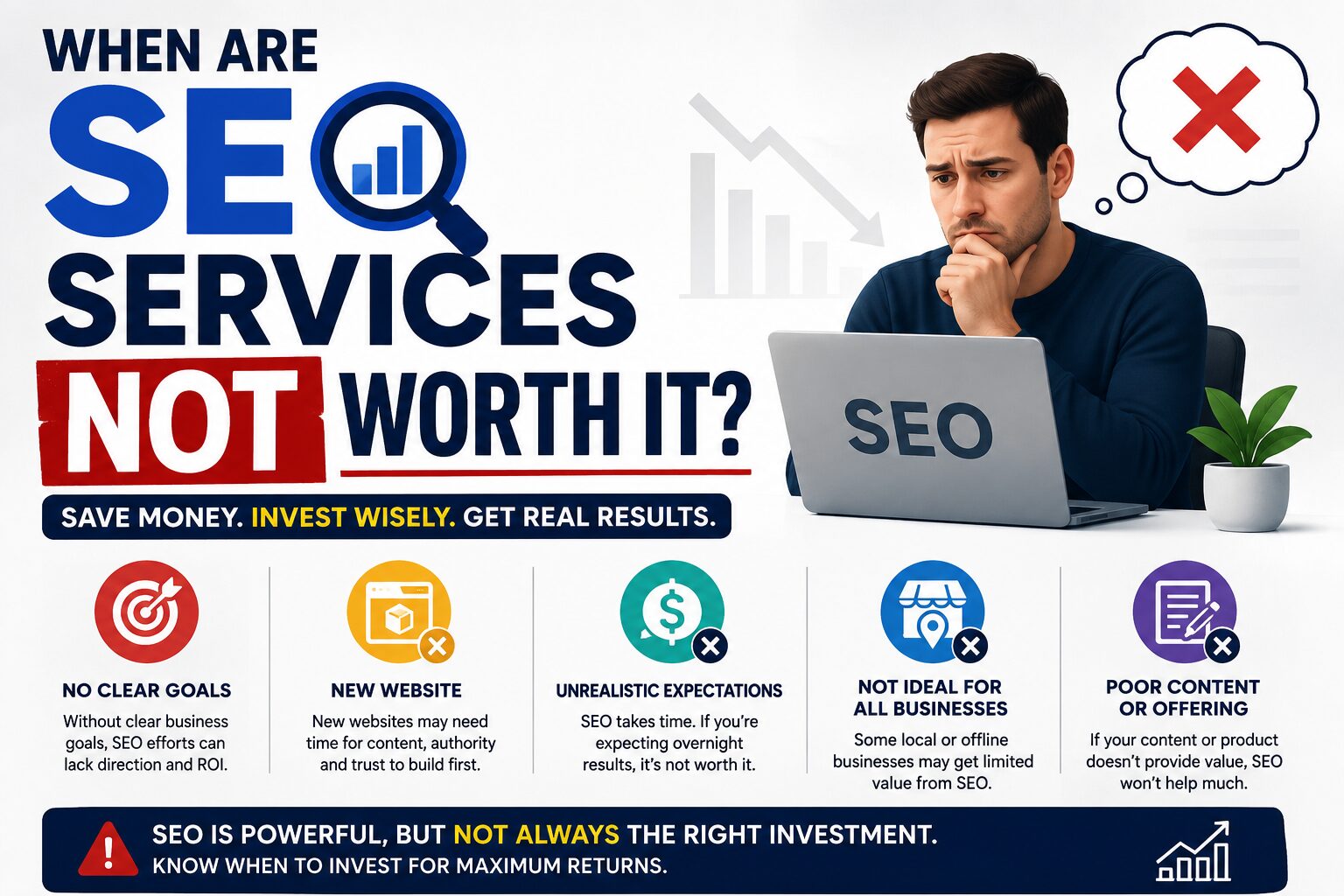
While organic search is incredibly lucrative, it is not a silver bullet for every single business setup. It may be wise to hold off on hiring a professional provider if you fall into any of the following categories:
- You Need Immediate Sales to Stay Afloat: If your company is facing an urgent cash crunch and needs closed revenue within the next two weeks, organic optimization is the wrong vehicle. You should instead invest your capital into high-intent Paid Search Ads (PPC) or direct cold outbound sales to secure fast revenue.
- Your Product is Completely Disrupted or Brand New: If you have invented a completely unique, revolutionary product that nobody has ever heard of, users won’t be looking for it in search bars. Your primary marketing goal should be focused on building social media awareness and PR rather than search capturing.
- You Treat Growth as a One-Off Project: Search algorithms update constantly, and aggressive competitors are always trying to outrank you. If you plan to fund a campaign for two months and then completely abandon it, your site will quickly lose its visibility. Success requires continuous, consistent maintenance.
Frequently Asked Questions (FAQs)
Q1: How long does it take to see results from professional SEO services?
Generally, it takes 4 to 6 months to start seeing tangible increases in rankings, organic traffic, and leads. SEO is a long-term compound growth strategy; the exact timeline depends entirely on your website’s history, current technical health, and keyword competition level.
Q2: Can I handle my business SEO on my own instead of paying an agency?
Yes, you can absolutely manage fundamental on-page optimization yourself if you have the time to learn. However, comprehensive modern SEO involves deep technical audits, constant algorithm adjustments, high-tier link building, and advanced content creation. Most business owners prefer outsourcing to experts so they can focus entirely on core business execution.
Q3: Why are some SEO packages so cheap, and should I buy them?
Cheap packages (under $300/month) almost always rely on automated bots, spammy PBN link building, and low-quality spun content. These outdated black-hat methods will eventually trigger manual penalties from search engines, permanently ruining your domain’s online credibility.
Q4: How does AI change the effectiveness of SEO services in 2026?
AI tools (like Google AI Overviews) make high-quality search engine optimization more critical than ever. Experienced providers now focus heavily on semantic search maps, entity authority, and clear brand positioning so that your business content is pulled directly into AI search citations and summaries.
Q5: Is it possible to guarantee a number one ranking on Google?
No, it is impossible for anyone to legitimately guarantee a specific number one position. Google’s algorithms update dynamically and factor in personalized user context like location and history. Reliable digital agencies focus on driving profitable conversions and aggregate visibility growth rather than empty rank vanity metrics.
The Final Verdict: Is It Right For Your Brand?
If you possess a clear understanding of your customer’s long-term lifetime value, have a sustainable budget of at least $1,500 per month, and maintain the patience to wait 4 to 6 months for real momentum to build, SEO services are one of the single most reliable, profitable, and valuable investments you can ever make for your digital business.