
You’ve probably wondered if affiliate links improve or worsen your search engine results if you own a blog, review website, or specialized content shop.
With Google’s ongoing updates targeting thin content and low-value reviews, staying on the right side of search engine guidelines while maintaining a profitable website requires a clear understanding of how affiliate links interact with search algorithms.
Here is the direct answer, followed by the strategies, technical directives, and best practices you need to succeed with affiliate SEO in 2026.
What Are Affiliate Links?
An affiliate link is a specific URL that contains a unique tracking ID or code assigned to a publisher. When a visitor clicks the link and completes an action—such as buying a product, signing up for a trial, or downloading an app—the merchant tracks the transaction and pays the affiliate a commission.
How Affiliate Links Work
- User Action: A reader clicks an affiliate link on your site.
- Cookie Drop: A small tracking file (cookie) is saved in the user’s browser for a predetermined amount of time (for example, 24 hours to 90 days).
- Conversion tracking: On the merchant’s website, the customer completes a purchase.
- Payout & Attribution: The merchant credits your account and attributes the sale to your unique ID.
Types of Affiliate Links
- Text Links: Anchored Tags within body paragraphs, product roundups, or comparison articles.
- Banner And Visual Ads: Dynamic or static images linked or relate to product pages.
- Product Review Buttons: Call-To-Action (CTA) buttons labeled “Check Price on Amazon” or “Buy Direct.”
- Native Shopping Widgets: Embedded comparison tools dynamically fetching live prices.
Do Affiliate Links Directly Help SEO?
No. Affiliate links do not act as positive ranking signals, nor do they pass “link juice” (PageRank) to help your site rank higher in search results.
┌──────────────────────────────────────────────┐
│ Do Affiliate Links Direct Boost SEO? │
│ ├── Direct Ranking Signal? ➔ NO │
│ ├── Pass PageRank/Authority? ➔ NO │
│ └── Indirect Organic Value? ➔ YES (If high │
│ quality) │
└──────────────────────────────────────────────┘
Google’s Official Position
Google views affiliate links only as business partnerships. According to Google Search Central guidelines, search engines view affiliate links as paid or sponsored connections. They do not pass organic authority, and Google’s algorithms explicitly aim to avoid ranking sites based on the presence or density of monetization links.
Affiliate Links vs. Ranking Signals

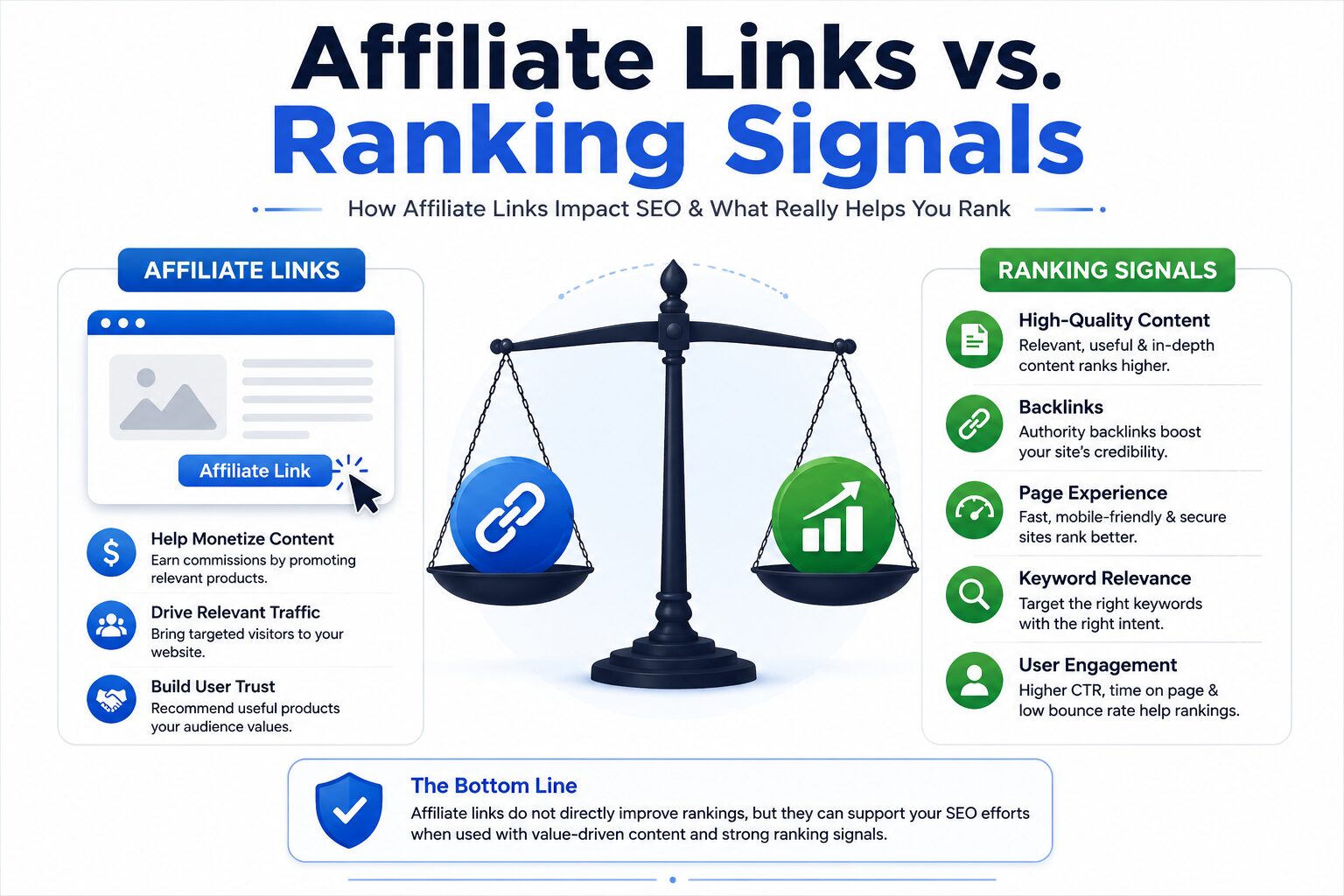
To understand why affiliate links do not directly boost SEO, consider how search engines process link equity:
| Link Property | Standard Editorial Link | Properly Tagged Affiliate Link |
| Passes PageRank? | Yes | No (rel=”sponsored” or rel=”nofollow”) |
| Direct Ranking Value | High (acts as a vote of trust) | Neutral (ignored for page authority) |
| Primary Purpose | Cite sources / build web context | Monetization & referral tracking |
| Risk Factor | Low (if natural) | Medium-High (if unmasked/unqualified) |
Can Affiliate Links Hurt SEO?
While adding affiliate links will not automatically penalize your site, abusing them or failing to wrap them in context can severely harm your organic visibility.
1. Thin Affiliate Content
Google’s helpful content systems and product review guidelines penalize pages that simply rehash manufacturer specs with an affiliate link attached. If your content offers no unique testing, real-world experience, or original research, algorithms flag it as thin affiliate content.
2. Overusing Affiliate Links
Drowning an article in repetitive affiliate links—such as linking every mention of a brand name—signals aggressive commercial intent over reader utility. High link density without added value hurts readability and raises spam flags.
3. Poor User Experience
Intrusive pop-ups, misleading anchor text (“Read free here” leading to a paid product page), or redirect chains that slow down load times cause high bounce rates and poor engagement signals, indirect factors that hurt rankings over time.
Benefits of Affiliate Links Beyond Rankings
Even though affiliate links do not directly pass PageRank, a strategic affiliate model offers significant indirect SEO advantages:
Better Monetization
A profitable site provides the capital required to invest back into high-quality content production, expert reviews, custom imagery, fast web hosting, and technical site performance—all of which directly improve SEO.
Increased Content Quality
To compete for affiliate commissions, publishers must write comprehensive, well-researched, and user-centric articles. High-intent commercial content often earns natural backlinks from other sites looking to reference thorough buyer guides.
Best Practices for Affiliate SEO
To protect your organic rankings while maximizing revenue, adhere to these search engine requirements:
Use rel=”sponsored”
Always qualify affiliate links using proper HTML link attributes. Google specifically recommends rel=”sponsored” for paid or affiliate URLs. If legacy systems prevent this, rel=”nofollow” is also acceptable.
HTML
<!– Recommended standard for affiliate links –>
<a href=”https://example.com/product?aff_id=123″ rel=”sponsored nofollow”>Check Best Price</a>
Add Clear Affiliate Disclosures
Place a clear, conspicuous affiliate disclosure at the top of your page before any affiliate link appears. This complies with FTC regulations and builds trust with readers and search evaluators alike.
Example Disclosure: “This page contains affiliate links. If you purchase through these links, we may earn a small commission at no additional cost to you.”
Write Original, High-Value Content
Follow Google’s Helpful Content and Product Review guidelines:
- Include hands-on evidence (photos, benchmark scores, or videos of you using the item).
- Explain pros, cons, and alternatives rather than just writing glowing praises.
- Discuss why a product may not be suitable for certain users.
Optimize Internal Linking
Structure your internal links naturally. Link your informational context hubs (e.g., “How to Choose a Mechanical Keyboard”) directly to your monetization pages (e.g., “10 Best Mechanical Keyboards of 2026”). This passes organic PageRank through clean, non-monetized paths within your site topology.
Common Affiliate SEO Mistakes
Avoiding these frequent errors will protect your domain authority:
- Hiding or Cloaking Links Inaccurately: Using URL shorteners or redirects to hide affiliate paths without applying rel=”sponsored” at the redirect header level.
- Ignoring Broken Links: Letting target products go out of stock or redirect to dead 404 pages.
- Relying Solely on Top 10 Listicles: Neglecting deep, single-product reviews, comparison tables, and how-to context guides.
- Ignoring Core Web Vitals: Loading heavy affiliate visual widgets that degrade page load speed and layout stability scores (CLS).
Affiliate Links vs. Regular Links
Understanding the fundamental difference helps you structure outgoing links across your domain:
Outgoing Links
├── Regular Editorial Links (Passes authority, uses rel=”dofollow”)
└── Monetized/Commercial Links (Blocked from PageRank, uses rel=”sponsored”)
- Editorial Links: Point to authoritative sources, reference articles, or secondary research. They pass PageRank and tell search engines how topics connect across the web.
- Affiliate Links: Commercial tracking links designed to monetize traffic. They must be isolated with attributes like rel=”sponsored” so search engines do not mistake them for unnatural or paid link schemes.
Final Verdict
Do affiliate links help SEO?
Directly, no. They carry no positive ranking signals and do not pass authority.
However, when managed responsibly with proper attributes (rel=”sponsored”), clear disclosures, and genuinely helpful content, affiliate links will not hurt your SEO either. They allow publishers to build scalable business models that fund top-tier content, high user experience, and long-term search growth.
Conclusion
Success in affiliate SEO comes down to user intent and compliance. Rather than trying to leverage affiliate links for ranking shortcuts, focus on providing exceptional user value through original testing, detailed comparisons, and clean technical site maintenance. Treat affiliate monetization as a reward for solving user queries—not as a substitute for quality content.
Frequently Asked Questions
Will Google penalize my site if I add too many affiliate links?
Yes, if high link density coincides with thin, unoriginal content. If every paragraph contains multiple affiliate links without providing original analysis, search algorithms may classify the page as spam. Keep link placement natural and focused on user benefit.
Should I use rel=”nofollow” or rel=”sponsored” for affiliate links?
Google officially recommends rel=”sponsored” for links that involve compensation, including affiliate programs. However, rel=”nofollow” remains acceptable. Combining them as rel=”sponsored nofollow” is widely considered best practice.
Does cloaking or shortening affiliate links hurt SEO?
Link cloaking (e.g., converting [merchant.com/?aff=123](https://merchant.com/?aff=123) to [yoursite.com/recommend/product](https://yoursite.com/recommend/product)) is safe as long as the internal redirect path carries a rel=”sponsored” attribute or a noindex header directive. Cloaking purely to hide commercial intent from users or search engines violates guidelines.