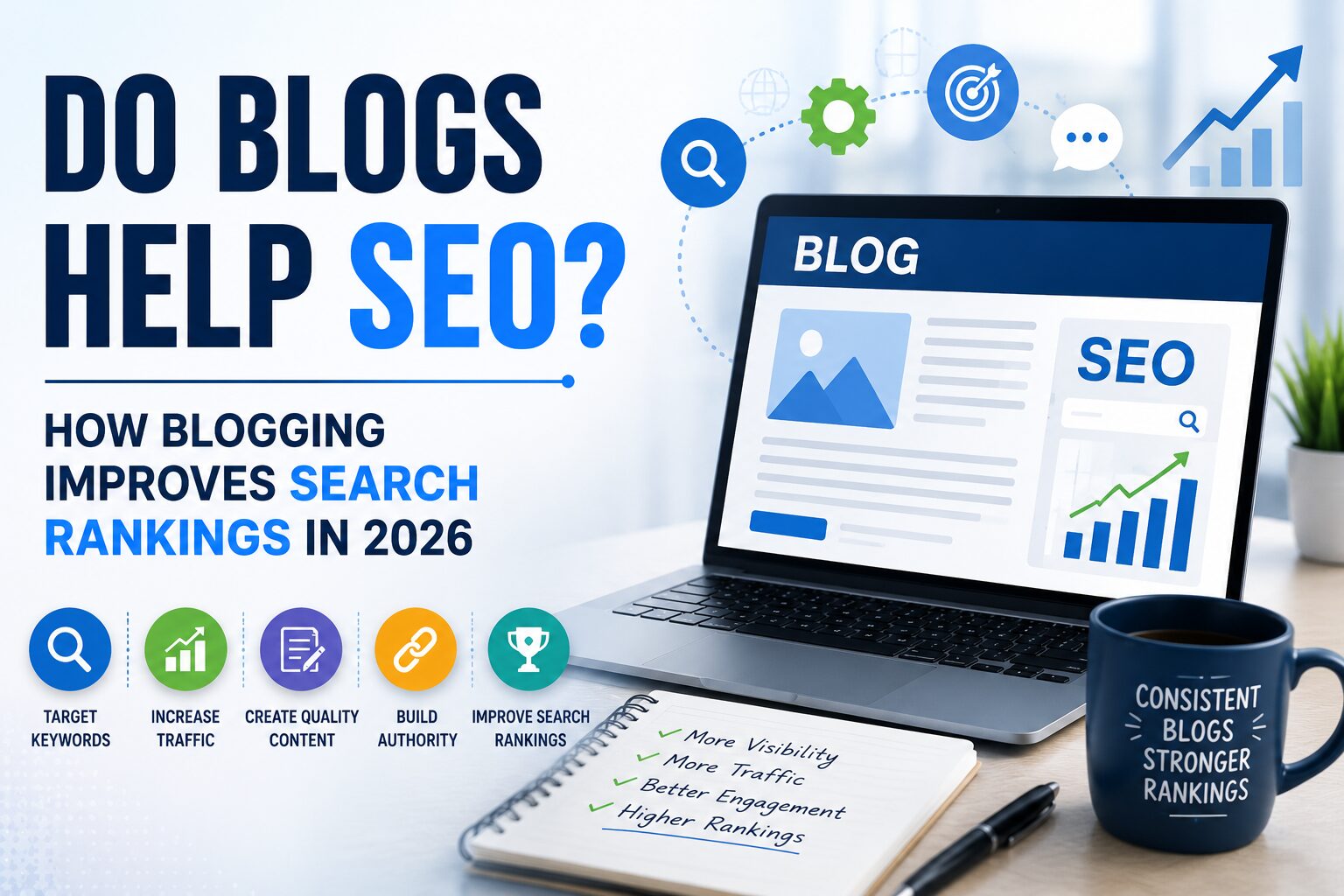
Yes, blogging can help SEO, but not simply because a website has a blog or publishes articles regularly. The real SEO value comes from creating useful, relevant, original content that answers questions people are searching for and connects naturally with the rest of your website.Instead of content produced exclusively to influence results, Google’s current Search Essentials emphasise content that is dependable, helpful, and prioritises people. Google also makes clear that following SEO best practices does not guarantee a page will rank, which is an important distinction for anyone investing in a blog strategy.
Think of your website as a library. Your service pages may explain what you sell, but a well-planned blog creates additional shelves covering the questions, problems, comparisons, and decisions surrounding your products or services. Each genuinely useful article can create another opportunity for your website to be discovered through organic search. That does not mean every article will rank, and it certainly does not mean publishing 100 thin posts will outperform 20 excellent ones. A blog helps SEO when it expands your useful search footprint while strengthening the overall relevance and usefulness of the website.
Why Google Values Useful Blog Content
Google’s guidance has increasingly centered on whether content is genuinely useful to people. Its documentation asks whether visitors leave a page feeling they have learned enough to accomplish their goal and whether the site has a clear purpose or focus. That makes an important difference to how you should approach SEO and blogging in 2026: the objective should not be to write an article simply because a keyword has search volume. The objective should be to solve a real problem better than competing pages.
Google specifically warns against producing large amounts of content across unrelated subjects merely because some pages might attract search traffic. It also cautions against simply summarizing what other websites already say without adding meaningful value. In practical terms, your blog should have a reason to exist beyond generating impressions. Add original examples, useful explanations, comparisons, experiences, data, processes, screenshots where appropriate, and insights that make the page genuinely worth reading.
How Blogging Supports Organic Search Visibility
A business website often has a limited number of core commercial pages. For example, a digital marketing agency might have pages for SEO services, content marketing, social media marketing, PPC, and web-related services. Those pages are important, but they cannot realistically answer every question a potential customer may type into Google. This is where blogging becomes powerful because it gives the website room to address the broader information ecosystem around its services.
Suppose someone searches for “does blogging help SEO?” They might not be prepared to buy SEO services just yet. Another person might search for “how often should a business publish blog posts?”, while another searches for “blogging vs landing pages for SEO.” These searches represent different stages of the buying journey. A strategic blog can address each one and then guide interested readers toward relevant service or product pages. Over time, this creates a connected content system rather than a collection of isolated articles.
Targeting More Search Queries
One of the clearest benefits of blogging is the ability to target a broader range of relevant search queries. Your homepage might target your brand or primary service, while your main service page targets something like “SEO services.” A blog can target hundreds of related questions and long-tail searches without forcing your commercial pages to become awkward keyword-heavy documents.
Google’s SEO Starter Guide explains that SEO helps search engines understand content and helps users find websites through search. It also recommends using words people would actually use when searching and placing relevant wording in prominent areas such as titles and headings. A blog naturally creates opportunities to do this because each article can be built around a specific topic and search intent.
The important word here is relevant. Publishing an article about an unrelated trending topic just to attract traffic may generate visits but does little to strengthen your business’s topical relevance. A strong SEO blog stays within a defined subject area and answers questions that make sense for the audience you want to attract.
Building Topic Authority
Imagine Google trying to understand whether a website is genuinely knowledgeable about a subject. One page about SEO might provide some information, but a well-organized collection covering keyword research, technical SEO, internal linking, content optimization, search intent, local SEO, link building, and measurement provides much more context.
That is where topic authority becomes useful as a strategic concept. You are not trying to prove expertise by repeating the same keyword dozens of times. Instead, you cover the important subtopics surrounding your primary subject and connect them logically. A comprehensive content ecosystem can help users and search engines understand what your website is about.
This is also why random blogging often produces disappointing results. If every article targets a completely different subject, your site may accumulate pages without developing a coherent topical focus. A strategic blog works more like a map: each article covers one destination, internal links connect related destinations, and your main service pages act as important commercial endpoints.
Blogging Helps You Target Long-Tail Keywords

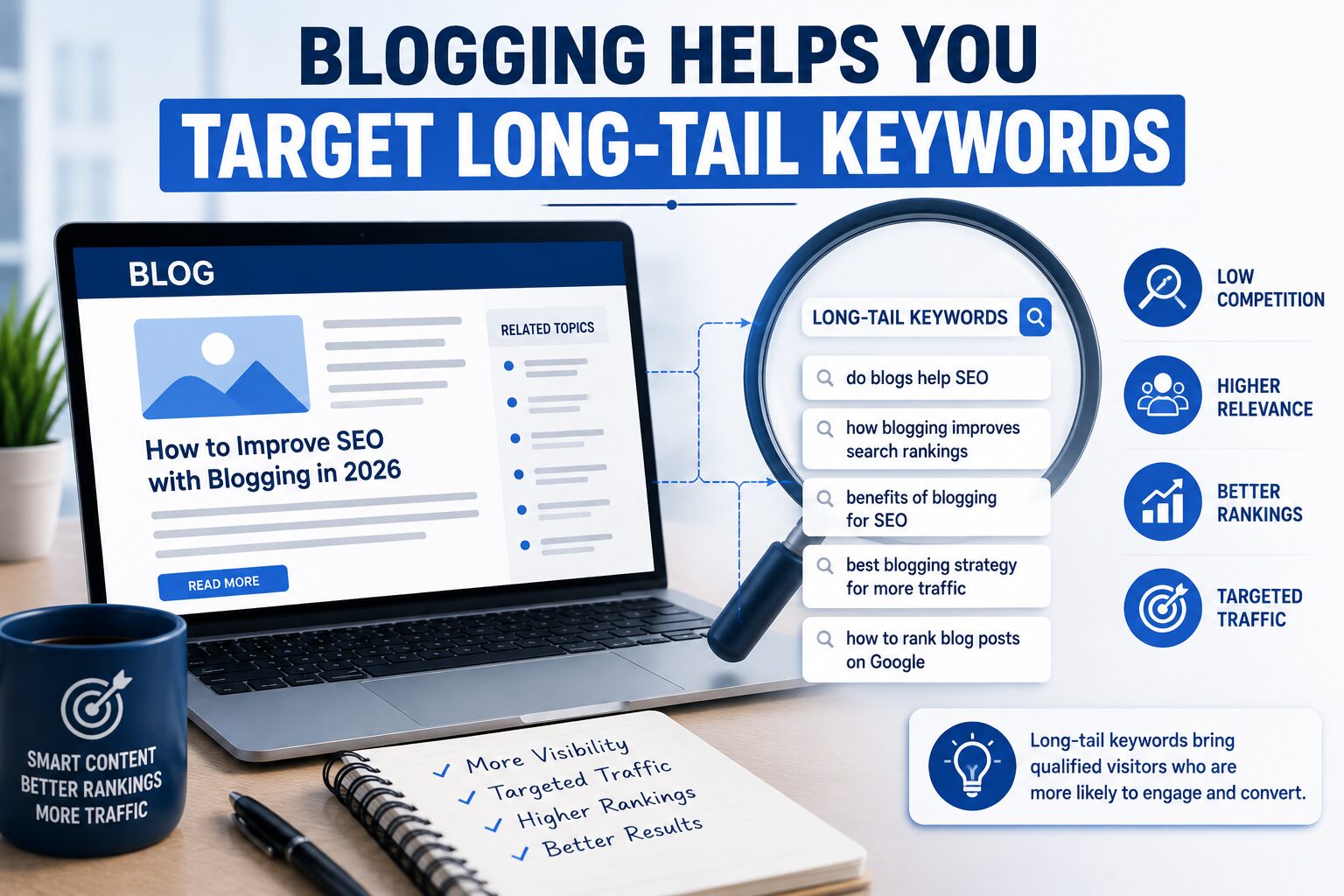
Long-tail keywords are often highly valuable because they express a more specific need. A user can look for “does blogging help SEO for small businesses?” rather than “SEO.” That second query tells you much more about what the person wants to know. A blog post can answer that exact question in depth without trying to force the phrase into a generic service page.
This makes blogging especially useful for businesses competing against large websites. A new or smaller website may struggle to compete immediately for extremely broad terms, but specific queries can provide opportunities to demonstrate expertise and attract highly relevant visitors. Long-tail content can also reveal what your audience actually cares about. If one article attracts impressions for dozens of related searches, those queries can inspire future content, updates, FAQs, comparisons, or service pages.
However, long-tail SEO should not become an excuse for publishing hundreds of near-identical pages. Google’s current guidance specifically warns against creating large quantities of content primarily for search engines. The better approach is to identify meaningful questions and create one strong resource when several closely related searches can be answered together.
Fresh Content Gives Search Engines More Pages to Understand
Blogging creates additional indexable pages, but more pages do not automatically mean better rankings. This distinction is critical. Google says that meeting technical requirements and best practices does not guarantee that a page will be crawled, indexed, or served in search results.
The value of publishing new content is therefore not simply “Google likes fresh websites.” Instead, a useful new article can expand the information available on your site, address a newly emerging question, update an older topic, and create new opportunities for relevant internal linking. For subjects that change frequently, maintaining accurate and current information can be particularly important.
A good blogging strategy therefore includes content maintenance, not just content creation. If you published an article several years ago and the information has changed, updating it may be more useful than publishing another article on a completely new keyword. Review outdated statistics, screenshots, examples, recommendations, links, and explanations. When appropriate, consolidate overlapping articles rather than allowing several weak pages to compete with each other.
Internal Linking Makes a Blog More Valuable for SEO
A blog becomes much more powerful when its articles are connected. Internal links help readers move from one relevant resource to another, while Google says links can help it discover pages and understand their relevance. Google specifically recommends crawlable links and descriptive anchor text, and says every important page should have at least one link from another page on the site.
Imagine publishing an article called “What Is Keyword Research?” Inside it, you could naturally link to another article explaining search intent, another about keyword clustering, and your SEO service page. Those connections create a logical pathway. A reader who arrives looking for basic information can gradually discover more advanced resources and eventually reach a commercial page when they are ready.
Internal linking also helps prevent valuable pages from becoming isolated. Instead of treating each blog post as a standalone destination, think of every article as part of a larger information network. The strongest links are contextual and genuinely useful rather than inserted merely because you want to distribute keywords.
Creating Topic Clusters With Internal Links
A topic cluster typically contains a broad pillar resource supported by several narrower articles. For example, a pillar page might cover “Complete SEO Guide,” while supporting articles cover keyword research, technical SEO, on-page optimization, internal linking, content strategy, and link building.
The goal is not to create an artificial linking pattern. The goal is to organize information in a way that makes sense to humans. If an article naturally mentions a concept that deserves deeper explanation, link to the relevant resource. If a supporting article discusses a broader subject, link back to the pillar page where appropriate.
Google’s documentation says internal links can help people and Google understand a website and discover other pages. It also states that there is no magical ideal number of links for a page. That means quality and context matter much more than hitting an arbitrary link count.
Blogs Can Help Earn Backlinks and Mentions
Another reason blogging can help SEO is that useful content gives other websites something worth referencing. A service page usually exists to sell something, while an original research article, detailed guide, calculator, benchmark, study, or genuinely useful resource can become a natural citation target.
For example, imagine a marketing company publishes original research about local SEO trends among 500 businesses. Other websites discussing local SEO statistics may reference that research. Those references can generate backlinks and brand exposure. The same principle applies to detailed tutorials, original frameworks, useful templates, data studies, and expert commentary.
There is no guarantee that publishing a blog post will earn backlinks. Simply writing a 2,000-word article does not make it link-worthy. The content needs a reason for another publisher, journalist, researcher, or website owner to reference it. This is why creating something genuinely useful is often a better link-building strategy than publishing generic articles and waiting for links to appear.
Blogging Improves Topical Relevance
A website that consistently publishes useful content around a defined subject can build a much richer topical footprint. Consider a company that sells SEO services. Instead of publishing random marketing articles, it could build a structured library around SEO strategy, keyword research, technical SEO, content optimization, local search, analytics, link building, and search trends.
This gives visitors multiple ways to discover the site. More importantly, it allows the business to demonstrate practical knowledge throughout the customer journey. Someone who finds a beginner article may later read an advanced guide, compare strategies, and eventually visit a service page.
Topical relevance should never become an excuse to repeat keywords. Search engines are sophisticated enough that simply mentioning a phrase repeatedly is not a substitute for useful information. A page about keyword research should explain the process, considerations, tools, mistakes, and decision-making involved rather than repeating “keyword research” in every paragraph.
How Blog Content Supports Different Search Intent
Search intent describes what a user is actually trying to accomplish with a query. Two keywords can appear similar while representing completely different expectations. If your content does not match that expectation, excellent writing alone may not be enough to perform well.
Informational, Commercial, and Transactional Intent
Informational searches usually indicate that someone wants to learn. Examples include “does blogging help SEO?”, “what is technical SEO?”, or “how does internal linking work?” Blog articles are naturally suited to these queries because they allow you to explain concepts in depth.
Commercial investigation searches indicate that someone is evaluating options. Searches such as “best SEO tools,” “SEO agency vs freelancer,” or “SEO services for small business” may require comparisons, evaluations, or buying guidance. A carefully written blog can support these searches while maintaining a helpful, objective tone.
Transactional searches usually show stronger purchase intent. These may be better served by product pages, service pages, category pages, or landing pages. The blog can still support the journey by answering questions and linking readers to the appropriate commercial destination.
Does Publishing More Blog Posts Improve Rankings?
No. Publishing more blog posts does not automatically improve rankings. This is one of the most persistent misconceptions about SEO blogging. If quantity alone produced rankings, every company could simply publish thousands of short articles and dominate Google.
Google’s current people-first guidance explicitly warns against producing lots of content on many topics in the hope that some pages will perform well. The better question is not “How many articles should I publish?” but “What useful information is missing for my audience?”
For one business, publishing one excellent article every week may be realistic. Another may benefit more from two deeply researched articles per month. A third may have enough existing content that updating and consolidating older pages is a better investment. Your publishing schedule should follow audience demand, available expertise, content quality, and business objectives rather than an arbitrary number.
Quality vs. Quantity in SEO Blogging
Quality is not simply word count. A 1,200-word article can be more useful than a 4,000-word article if it answers the user’s question directly, provides original insight, and avoids unnecessary repetition. At the same time, a complex topic may genuinely require substantial depth.
The real measure is whether the article satisfies the user’s need. Google asks whether readers will leave feeling they have learned enough to achieve their goal. That is a much more useful editorial standard than trying to hit a particular word count.
Avoid padding articles with repetitive introductions, generic statements, or sections that exist only to increase length. Instead, use examples, explanations, comparisons, practical steps, original observations, and evidence. Write for the person who searched the query, not for an imaginary word-count algorithm.
How to Create SEO-Friendly Blog Posts in 2026
SEO blogging in 2026 requires more than inserting a focus keyword into a title and repeating it throughout an article. Google’s current Search Essentials emphasize helpful, reliable, people-first content, relevant wording, crawlable links, and appropriate technical implementation.
Before writing, identify the search intent and study what a successful answer needs to accomplish. Then develop an article structure that moves logically from the user’s question to the answer, supporting details, examples, and practical next steps. Use headings to make the content easy to scan, but do not create dozens of headings simply to manipulate structure.
Start With Search Intent
Start by asking: Why did someone search this phrase? If the keyword is “does blogging help SEO,” the person probably wants a straightforward explanation of the relationship between blogging and search visibility. They may also want practical examples, benefits, limitations, and a strategy for using blogs effectively.
Once you understand the intent, identify the questions surrounding it. What would a beginner ask next? What misconception needs clarification? What evidence would make the explanation more convincing? What practical action can the reader take after finishing the article?
This approach produces naturally comprehensive content because you are following the reader’s thought process rather than blindly following a keyword list.
Optimize Titles, Headings, and Content
Use your primary keyword naturally in the title, introduction, relevant heading, and body where it genuinely fits. Google recommends using words people would use to find your content in prominent locations such as titles and headings.
At the same time, avoid awkward keyword stuffing. Your headings should describe what the section actually covers. Supporting phrases should appear naturally because you are discussing related concepts, not because you have created a checklist requiring every variation.
Also pay attention to the page’s URL, meta description, images, internal links, and overall readability. SEO is a system rather than a single keyword placement exercise.
The Role of Originality and First-Hand Experience
Originality is increasingly important in a crowded search environment. If ten websites publish essentially the same generic explanation, another copy adds little value. Your opportunity is to provide something the reader cannot get from every other page.
That might come from first-hand experience, original examples, proprietary data, expert commentary, screenshots, experiments, case studies, or a distinctive framework. Even a simple tutorial becomes stronger when it includes practical lessons learned from actually performing the task.
Google’s people-first guidance emphasizes original and useful content and warns against merely summarizing existing information without adding value. That principle matters even more as content production becomes easier through AI tools. If everyone can generate a basic article about the same topic, the differentiator becomes the usefulness and originality of what you add.
Blogging and Google AI Overviews in 2026
Search is no longer limited to traditional blue links. Google has continued expanding AI experiences such as AI Overviews and AI Mode, and its current guidance says the fundamental principles for succeeding in these experiences are consistent with its broader Search guidance: create unique, satisfying, useful content and make sure Google can access and understand it.
This creates another reason to avoid generic blog content. AI-powered search experiences can synthesize information from multiple sources, meaning your article needs to provide information that deserves to be surfaced. Clear explanations, original insights, useful evidence, strong organization, and unique perspectives can make a page more valuable than a generic rewrite of information already available elsewhere.
Google also says that its AI search guidance continues to rely on established SEO fundamentals. In its 2026 documentation updates, Google specifically highlighted the importance of non-commodity content and explained that SEO best practices remain relevant to generative AI features.
Common Blogging Mistakes That Can Hurt SEO
One of the biggest mistakes is treating blogging as a numbers game. Publishing dozens of low-value posts can create a large website without creating a useful one. Another common mistake is targeting keywords without understanding intent, resulting in articles that technically mention the phrase but fail to answer the question behind it.
Other problems include keyword stuffing, duplicate or heavily overlapping articles, weak internal linking, outdated information, generic introductions, excessive filler, poor mobile usability, and publishing content outside the site’s core area of expertise. AI-assisted content can also become problematic when it is used to generate large amounts of pages without meaningful value. Google states that generating many pages with AI without adding value can violate its spam policy on scaled content abuse.
A strong editorial process should therefore ask whether each article deserves to exist. If the answer is no, do not publish it simply because a keyword tool suggested the phrase.
How to Measure Whether Blogging Is Helping SEO
You cannot determine whether blogging is working simply by counting published articles. Instead, measure outcomes such as organic impressions, clicks, rankings for relevant queries, organic traffic, engaged visits, conversions, assisted conversions, and the number of valuable pages receiving search visibility.
Google Search Console is particularly useful because it can show which queries and pages are appearing in Google Search. Google’s support documentation recommends Search Console for monitoring performance and checking whether Google can index your website.
Look for patterns rather than obsessing over one ranking position. An article that begins ranking for hundreds of relevant impressions may be developing traction even before it produces significant traffic. Likewise, a page that generates fewer visitors but produces qualified leads may be more valuable than a high-traffic article attracting people who have no interest in your business.
A Practical SEO Blogging Strategy for Businesses
A practical strategy starts with your business goals and audience problems. Build a list of topics that your customers genuinely care about, then organize those topics according to search intent and the customer journey. Prioritize subjects where your business can provide real expertise rather than trying to compete for every possible keyword.
Next, create pillar resources and supporting articles. Connect them through useful internal links, and make sure your important commercial pages are accessible from relevant content. Google recommends descriptive internal anchor text and says internal links can help users and Google understand your site’s pages.
After publishing, monitor performance and improve the content. Update information when it becomes outdated, strengthen weak sections, add useful examples, improve internal links, and consolidate pages when several articles target essentially the same intent. Google’s guidance notes that SEO improvements can take time to show results, with some changes taking days and broader site-level improvements potentially taking months to be recognized.
The most effective blogging strategy is therefore a cycle:
- Research real audience questions.
- Match each topic to search intent.
- Create genuinely useful content.
- Connect related pages with internal links.
- Promote valuable resources where appropriate.
- Measure performance in Search Console and analytics.
- Update, improve, consolidate, and expand content over time.
Conclusion
So, do blogs help SEO? Yes, they can be an important part of an effective SEO strategy in 2026, but blogging itself is not a ranking shortcut. A blog helps when it gives your website more opportunities to answer relevant searches, build topical depth, attract qualified visitors, strengthen internal linking, demonstrate expertise, and potentially earn references from other websites.
The biggest mistake is assuming that more articles automatically equal better rankings. Google’s current guidance points in the opposite direction: create helpful, reliable, people-first content rather than content produced primarily to attract search engines.
If you want blogging to contribute to SEO, think beyond publishing frequency. Build a useful content ecosystem around your audience’s questions, connect articles intelligently, demonstrate original knowledge, keep important information updated, and measure whether the content actually contributes to meaningful business outcomes. In 2026, that approach is far more sustainable than chasing keyword density, arbitrary word counts, or large volumes of AI-generated articles.
FAQs About Blogging and SEO
1. Does blogging help SEO rankings?
Yes, blogging can support SEO rankings by creating useful pages that target relevant search queries, answer user questions, build topical coverage, and provide opportunities for internal links. However, publishing a blog post does not guarantee rankings. Google states that following its Search Essentials does not guarantee that a page will be crawled, indexed, or shown in search results.
2. How often should I publish blog posts for SEO?
There is no universal publishing frequency that guarantees better rankings. A better approach is to publish consistently at a quality level your business can maintain. One highly useful article can provide more SEO value than several thin posts that do not satisfy search intent. Focus on relevance, originality, accuracy, and usefulness rather than publishing simply to hit a monthly article target.
3. Does blogging help small businesses with SEO?
Yes. Blogging can give smaller businesses opportunities to target specific questions and long-tail searches that may be difficult to address through commercial pages alone. A focused blog can also demonstrate expertise and connect informational content with relevant service or product pages. The key is to focus on subjects closely related to the business and the problems its customers actually need to solve.
4. Can AI-generated blog posts rank on Google?
AI-assisted content can appear in Google Search, but using AI to mass-produce pages without adding meaningful value can create SEO problems. Google says generative AI can be useful for research and structure, but generating many pages without adding value may violate its scaled content abuse policy. The safest approach is to use AI as a tool while maintaining human oversight, originality, accuracy, expertise, and genuine value.
5. How long does blogging take to improve SEO?
There is no fixed timeline. Some improvements can become visible within days, while broader site-level improvements may take several months as Google’s systems evaluate the site’s content over time. Results also depend on competition, website authority, technical SEO, content quality, search demand, internal linking, and how well the content satisfies users.